Export from Design Project
You can export different files by different ways from you design project.
Save the design view as image file
- A design project is open.
- The pattern has a design which you want to save as image file.
- 95
- Open the context menu of the design view with the RMB.
- 96
- Click the Export as Image File... menu item.
- 97
- Select the file format of the image, enter a name, select the path and save it.
- The complete design view is saved.
Save fabric view as image file
- A design project is open.
- 98
- Open the context menu of the fabric view with the RMB.
- 99
- Click the Export as Image File... menu item.
- The following dialog box appears with settings about saving:
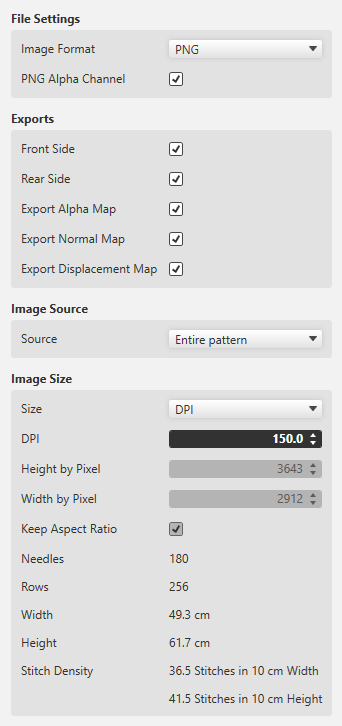
Image Format
-
PNG with or without transparency
 Export the fabric view for further processing to a 3D apparel software always as PNG with enabled transparency (PNG Alpha Channel).
 -
JPG with specification of the quality
The fabric view as JPG is always exported with a black background.
Exports (Variants)
So-called Maps are used for the 3D visualization and 3D simulation to assign two-dimensional images to the three-dimensional surfaces of the models.
The different types of Maps give a more detailed and realistic appearance to the computer generated 3D models.
- Front Side
- Rear Side
- Alpha Map
- An alpha Map contains information about transparent areas of a texture.
In a 3D software it is required to define the transparent space. - Normal Map
- Also referred to as Bump Map.
- The Normal Map specifies the angle, with which virtual light is reflected over a digital surface.
- With it the appearance of the texture depth is simulated.
- The Normal Map is a necessary part of digital textures in a 3D software.
- Displacement Map
- Also referred to as Height Map.
- A Displacement Map can artificially generate an additional height of a digital texture.
- This way, a more realistic appearance of three-dimensional surface structure results within a 3D model.
Image Source
- Entire pattern
- Select, if a complete fabric is to exported.
- Selected Area
- Exports only the desired, selected section of a pattern.
This function is helpful in case cycles are to be used in a 3D apparel software. - Current Image Section
- Exports only the area that currently appears in the document window of the fabric view.
- Keep Aspect Ratio
- The size ratio of the pattern is maintained.
Create a new pattern project from the design.
You can create a new pattern project within CREATE PLUS only.
This selection is not available in the CREATE DESIGN
.
- You are working with CREATE PLUS
- A design project is loaded and ready to export.
- 100
- Click
 New Pattern Project in the Export group of the Start ribbon tab.
 - The New Design Project from Design Pattern dialog box appears.
- 101
- Select machine in the New Design Project from Design Pattern dialog box.
- 102
- Enter the pattern name.
- 103
- Switch the comb for the start on or off.
- 104
- Select the desired design from the Design Project.
- A new pattern project will be created.
Render a Fabric Piece
You can save your Design for 3D simulation.
- A design project is open.
- 105
- Click
 Render Fabric Piece in the Export group of the Start ribbon tab.
- The Export dialog box appears with settings about rendering.
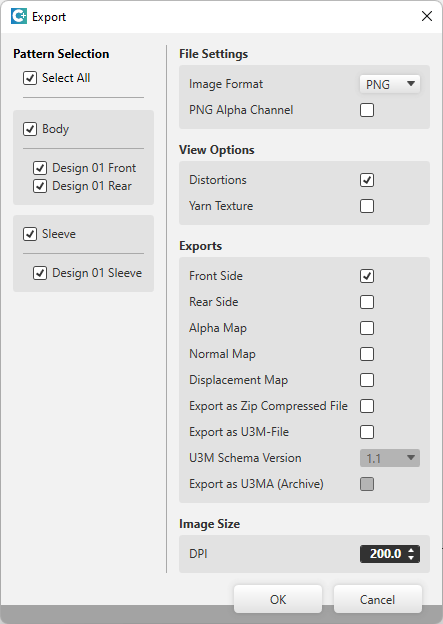
Pattern Selection
- Select the desired patterns for export.
File Settings
Image Format
-
PNG with or without transparency Export the fabric view for further processing to a 3D apparel software always as PNG with enabled transparency (PNG Alpha Channel).
-
JPG with specification of the quality
The fabric view as JPG is always exported with a black background.
View Options
- Distortions
- Shows the stitch distortion in the generated image file.
- Yarn Texture
- Shows the thread in the generated image file with yarn texture.
Exports (Variants)
So-called Maps are used for the 3D visualization and 3D simulation to assign two-dimensional images to the three-dimensional surfaces of the models.
The different types of Maps give a more detailed and realistic appearance to the computer generated 3D models.
- Front Side
- Rear Side
- Alpha Map
- An Alpha Map contains information about transparent areas of a texture.
In a 3D software it is required to define the transparent space. - Normal Map
- Also referred to as Bump Map.
- The Normal Map specifies the angle, with which virtual light is reflected over a digital surface.
- With it the appearance of the texture depth is simulated.
- The Normal Map is a required part of digital textures in a 3D software.
- Displacement Map
- Also referred to as Height Map.
- A Displacement Map can artificially generate an additional height of a digital texture.
- This way, a more realistic appearance of three-dimensional surface structure results within a 3D model.
- Export as Zip Compressed File
- File is saved compressed
- Export as U3M-File
- U3M is a standardized format for 3D visualization.
This includes physical properties data and texture maps, all combined into one ZIP file (U3MA). - U3M Schema Version
- Select the U3M schema version
- Export as U3MA (Archive)
- Export the files compressed in a U3MA ZIP file
Image Size
- DPI
- Specify the image size by DPI
Saving shapes as DXF files speichern
You can export shapes from your design project as a DXF file.
- A design project is open.
- Shapes are loaded or created
- 106
- Click
 Export as DXF File in the Export group of the Start ribbon tab.
- The Export Shapes dialog box appears.
- 107
- Select the desired shapes in the Export Shapes dialog box and confirm it.
- 108
- Enter a name and select the folder where the shapes are to be saved.
- The shapes will be saved as DXF file.