Working with the racking correction (VCI)
Open Correction du chevalement (VCI) and change the entry in the local knitting element:
- The
 Correction du chevalement (VCI) control column is displayed.
- 1
- Open the desired local knitting element with double-click, e.g. Torsade 3x3.
- 2
- Open the selection list in the Accueil ribbon at
 Fenêtre Outils
  and select
  Données Setup.
- or -
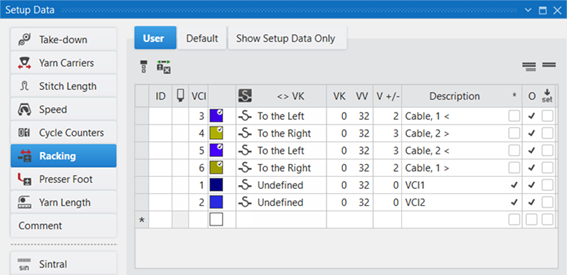
Click the Données Setup symbol directly under Paramètre. - The Données Setup tool window appears.
- 3
- Select the Par défaut tab for the selection of an 'unused' entry.
- or -
Select the Utilisateur tab for the selection of an 'used' entry. - 4
- Select the desired racking correction index in the
 column and enter it in the knitting element, in the Correction du chevalement (VCI) control column of the technical row for 'transfer'.
Options in the toolbar
|
|
Selecting the default value to enter in the control column |
|
|
Deleting an entry in the control column |
|
|
Show Pattern-related Values |
|
|
Hide Pattern-related Values |


Meaning of Columns of the Correction du chevalement (VCI) Table
|
Column |
Display |
Setting range | |
|---|---|---|---|
|
ID / IDv / ID^ |
Consecutive numbering and sorting of the entries | ||
|
|
Selecting the line to enter it in the control column | ||
|
VCI |
Index for the indirect allocation of the racking correction |
VCIn | |
|
Color |
Display of colors to enter in the control columns | ||
|
|
The column is displayed only in the Utilisateur tab | ||
|
|
Lines (entries) newly added in the Utilisateur tab | ||
|
|
Racking correction index from the Par défaut tab | ||
|
<> VK |
Direction of the racking correction
|
n = A – Z < = to the left > = to the right | |
|
VK |
Racking correction value |
m = 0 -10, ? ? = undefined value m = 0: No correction | |
|
VV |
Racking speed |
VV = n | |
|
V +/- |
Overracking
|
V+/- n | |


|
Column |
Display | |
|---|---|---|
|
Description |
Comment on the use of the entry. | |
|
* |
|
Entry is not defined as favorite, meaning the entry is only within the Par défaut table available. |
|
|
Entry is defined as favorite, meaning the entry is available within the Utilisateur table or directly via the context menu of the control columns. | |
|
O |
|
Value cannot be overwritten (Overwrite) by a value of another table. |
|
|
Value can be overwritten (Overwrite) by a value of another table. (Default) | |
|
|
|
The entry will not be applied to the Setup data
|
|
|
The entry will be applied to the Setup data.
| |
|
G |
|
All settings of the Par défaut or Utilisateur table are STOLL defaults (STOLL Template).
|
|
|
These settings of the Par défaut or Utilisateur table are now User Standards (User-Template)
| |

 : All entries used in the pattern are applied by default to the Setup data.