Width adaptation in the k&w Arrangement Editor
For k&w Arrangements with a closed outer edge, the narrowings of both knitting layers must be executed simultaneously so that no holes are formed at the outer edge.
For some k&w Arrangements, the number of knitted rows up to the narrowing varies for both knitting layers. If the respective next shape row of both layers varies in width for this reason, the outer edge would be opened when narrowing occurs.
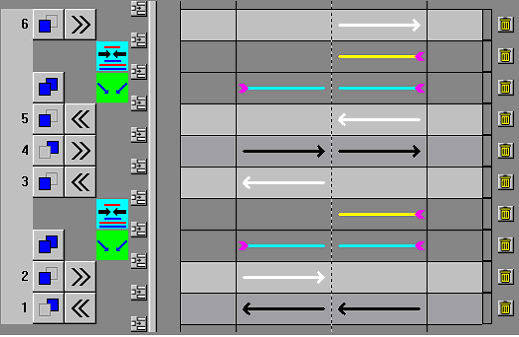
In order for the widths of both knitting layers to be adapted to one another during narrowing, the following commands are available in the k&w Arrangement Editor:


A position specification can determine the position at which the respective width adaptation is to be executed.

No width adaptation is required for the following situations:
|
Situation |
Presentation in the knitting cycle editor and in the shape view |
|---|---|
|
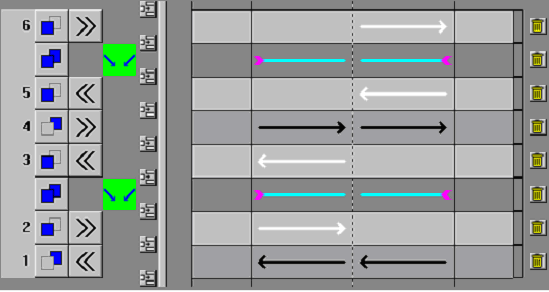
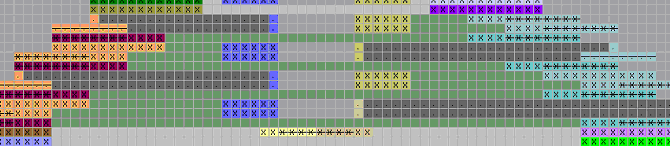
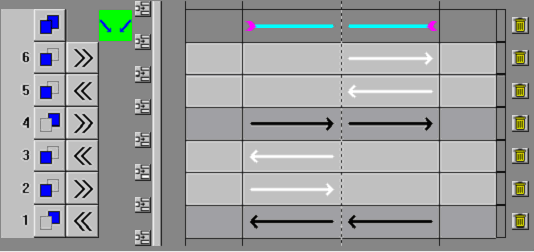
Narrow both layers and both knitting layers have knitted equally as often at the time of narrowing. Example: Knitting cycle with V-neck; both knitting layers are narrowed at the outer edge. Notice: Narrowing is only allowed if both knitting layers have knitted evenly. |
As both layers have knitted equally (twice) at the time of narrowing, no width adaptation commands are required.
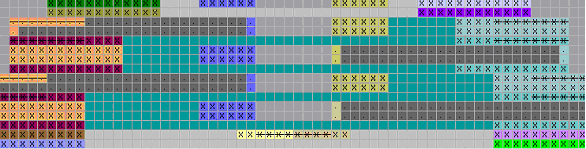
Shapes without knitting cycle: Shapes with knitting cycle: |
|
Narrow one knitting layer only. Example: Knitting cycle with V-neck; only the front layer is narrowed in the V-neck. |
Only the front knitting layer is narrowed. No width adaptation commands may be used.
Shapes without knitting cycle: Shapes with knitting cycle: |

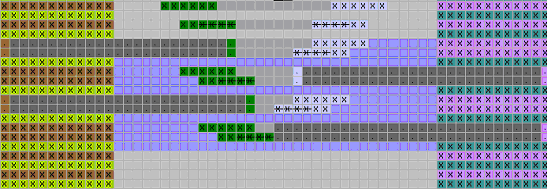
A width adaptation is required for the following situations:
|
Situation |
Presentation in the knitting cycle editor and in the shape view |
|---|---|
|
Both knitting layers narrow together and, at the time of narrowing, have not narrowed the same and can thus have different widths. | |
|
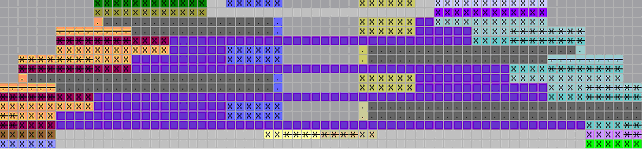
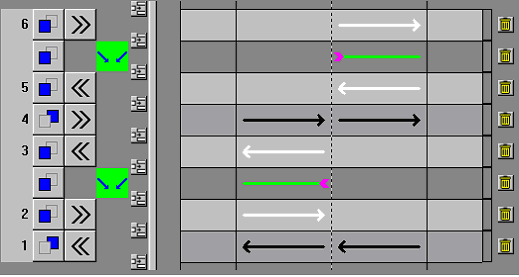
Example (with width adaptation): |
The wider layer (front) is adapted to the narrower layer (back) via .
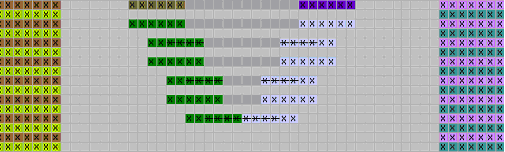
Shapes without knitting cycle: Shapes with knitting cycle: Notice: Width of layer 0 is adapted to layer 1. |
|
Example (without width adaptation): Notice: This example cannot be knit. |
As one shape row was processed on the right body side at the rear and no shape rows were processed on the front at the time of narrowing, only the back layer is narrowed. This is because the shape row with the narrowing at the front was not yet processed.
Shapes without knitting cycle: Shapes with knitting cycle: Notice: Layer 0 has not yet knitted and thus does not narrow. |