Autarkic yarn carriers
Autarkic yarn carrier:
|
ADF yarn carriers |
Function |
|---|---|
|
|
Yarn carriers are moved autarkic in horizontal and vertical direction |
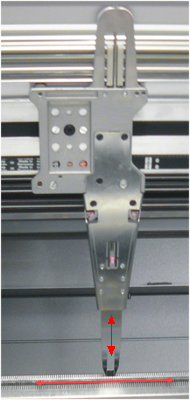
Rail allocation with 32 autarkic yarn carriers:
- At the yarn carriers of the rails 1-4, the yarn carrier tips are closed at the front - open at the rear for threading-up
- At the yarn carriers of the rails 5-8, the yarn carrier tips are open at the front for threading-up - closed at the rear
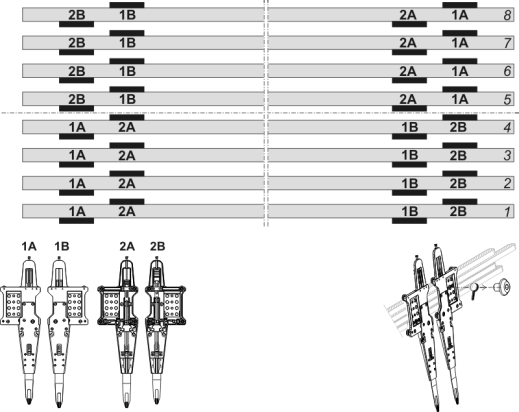
Two different construction types:
- Yarn carrier 1A corresponds to the yarn carrier 2B
- Yarn carrier 1B corresponds to the yarn carrier 2A
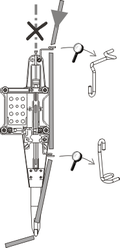
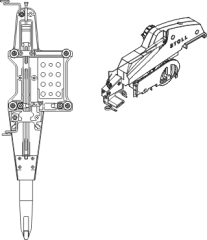
Spezial yarn carrier with yarn bypass:
|
Yarn Carriers |
Threading up |
|---|---|
|
|
Bypass:
|
|
| |
|
Usage of the yarn carrier with bypass |
Explanation |
|
The yarn is too thick, and cannot be threaded in the yarn tube |
|
After the carriage reversal, the yarn is to be fetched back (tensioned) by the tension arm of the yarn control unit so that no yarn loop is formed. The increased friction results in a yarn loop, which leads to a fault in the fabric (yarn loop, hole, drop stitch, yarn breakage). |
- 113
- Open the covers.
- 114
- Move the yarn carrier to a position where it can be threaded it up easier - for example outside the knitting area.
- 115
- Thread up yarn carrier.
Use the threading aid (1) for it. The threading aid is included in the accessories. 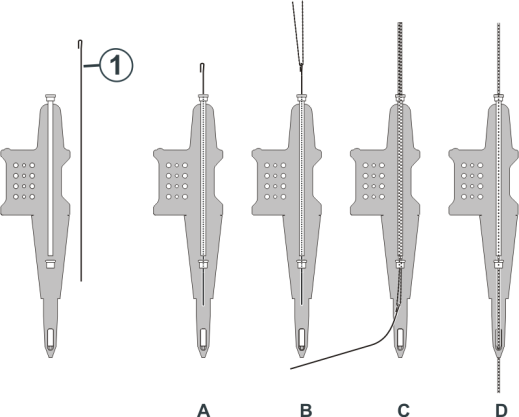
- 116
- Push the threading aid downward through the little yarn tube (A).
- 117
- Form a thread loop (B) (approx. 30 cm), double the thread for it.
- 118
- Pull the threading aid downward (C).
- 119
- Unthread the thread loop and thread it manually into the yarn carrier tip (D).
- 120
- Hold the yarn end.
PERIGO

The yarn carrier returns to its knitting or clamping position!
Danger of crushing and cutting by yarn carrier movement.
- Yarn carriers that have been moved manually will automatically return to their previous position when the engagement rod is pulled.
- Do not reach in the area of the yarn carriers.
- Pull the engaging rod upward to the reduced speed only.
- 121
- Pull the engaging rod upward cautiously.
- The yarn carriers move automatically back into their knitting position.
- 122
- If the yarn carriers are in their knitting position, the carriage starts moving and inserts the thread in the needles.
- 123
- When the thread is inserted securely in the needles, release the engaging rod.
- The carriage stops.
- 124
- Release the yarn end and close the covers.
- 125
- Keep moving the carriage until the reversing position is reached and stop it.
- 126
- Remove the yarn end.
- 127
- Continue the production or begin a new fabric.