Step by Step to Training Pattern
- 1
- Creating a pattern project with one pattern and the desired settings.
- 2
- To draw select any desired drawing tool under the Ferramentas de desenho group.
- 3
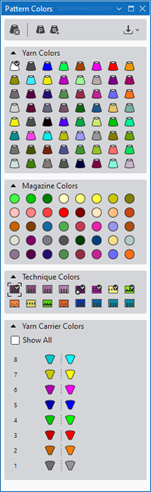
- In the Cores da amostra tool window select the desired pattern color from the Cores de fio color palette:
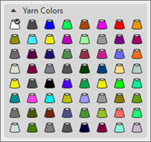
- Cores de fio:
-
 : The yarn carriers are not automatically placed on the yarn carrier rails.
The yarn carrier home position is determined in the Processamento técnico.
- Cores de depósito
-
: The yarn carriers are not automatically placed on the yarn carrier rails.
The yarn carrier home position is determined in the Processamento técnico. - Cores técnicas (do not use to create a design pattern)
-
: Yarn carriers are automatically placed on the yarn carrier rails due to STOLL default settings and are taken into account during the determination of the yarn carrier home position during the Processamento técnico.
- Cores de guia-fios
-
: Yarn carriers are automatically assigned to a yarn carrier rail and remain unchanged during the determination of the yarn carrier home position during the Processamento técnico.
|
|
|
|
For drawing the design pattern, with it several yarn carriers may be necessary for each yarn color.
| |
|
For drawing the design pattern, with it one yarn carrier is used for each magazine color.
| |
|
Draw the design pattern by yarn colors or magazine colors in order to get common yarn carrier home positions (order related data) for all the pattern within the order. | |
|
|
For drawing the design pattern, with a yarn carrier already positioned on the corresponding rail for each yarn carrier color in use.
Result:
|
|
Cores técnicas for creating or changing technical modules.
| |




- 4
- Draw the motif with the desired yarn color.
: When drawing the motif pay attention if necessary to even numbered heights of the color areas!
- 5
- Click the
 Início button under Pré-visualização in the Guia-fios ribbon.
 - The document window is opened as view and the Guia-fios ribbon appears.
- 6
- Open the Guia-fios tool window.
In Guia-fios group -> Exibir guia-fios
 - The Guia-fios tool window appears with the Fios e guia-fios disponíveis tab active.
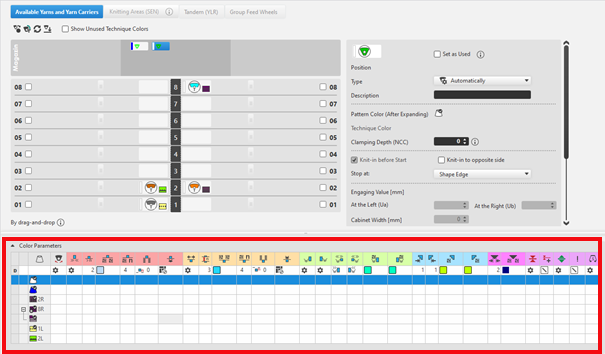
:
For each color in the pattern color tables used in the design pattern, a color area is created in the color parameter table. This means that you can make only one preset for this color area.
For pattern related, different changes of a color area sub-colors must be created. You have to draw them manually in the design pattern at the point to be changed. Then, other specifications can be set in the color parameter table.
Structure and column headers of the Parâmetros de cor table:
Group 1: General / Table header:
-
1st row:
All the symbols identifying the table columns -
2nd Row 'D'
Default settings for the respective column
Settings from the STOLL file - cannot be modified at the moment
: Default settings are applied from a STOLL file and cannot be modified at the moment.
These are automatically applied to all colors without specifications.
|
| ||
|
Group 1: General | ||
|
| ||
|
1. Column |
Entry D for the definition of the 2nd row of the table | |
|
2. Column |
Display for available sub-colors | |
|
|
Cor |
Display of all the colors used in a project
|
|
|
Guia-fios tece uma cor de sistemas múltiplas |
Specifications with multi-system knitting |
|
|
Guia-fios tece uma cor de vanizagem |
Specifications with plating |
|
|
Bascular |
Settings for the swivelling of intarsia yarn carriers or of autarkic yarn carriers |
|
|
Quantity of pattern rows for knitting-out, SEN edge and clamping
|
Specify the maximum distance between the color fields of the yarn carrier.
|

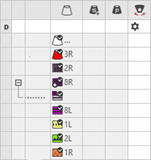


|
Group 2: Knitting-in | ||
|
| ||
|
|
Direção de início |
Specification of the knitting direction for the first row of a color (color area) |
|
|
Número de colunas sem Entrar tecendo |
Quantity of columns (needles) without Knitting-In module |
|
|
Módulo para entrar tecendo |
Specification of the knitting mode for knitting-in
|
|
|
Largura de repetição para entrar tecendo |
Presetting of the module width in total for the knitting mode of feeding-in the yarn carrier
|
|
|
Deslocamento de fileiras para desprender |
Column appears automatically if a module for knitting-in with casting-off is used |
|
|
Fileiras de offset para entrar tecendo |
Knitting-in of the yarn carrier by x rows before the beginning of the color area
|
|
|
Nó / Conexão no início |
Presetting a module for knot / binding at start of a color area without / with knitting-in. |
|
|
Offset de coluna para entrar tecendo com nó |
Move the position of a knot (module) by x columns to the left or right.
|
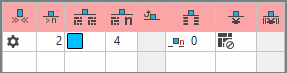

: The direction of knitting-in of a yarn carrier is always carried out from last position.
|
Group 3: Knitting-out | ||
|
| ||
|
|
Direção de saída da tricotagem |
Preset of the direction for knitting-out of the yarn carrier at the end of a color area |
|
|
Módulo para sair tecendo |
Preset of the knitting mode (module) for knitting-out
|
|
|
Largura de repetição para sair tecendo |
Presetting of the module width in total for the knitting mode of feeding-in the yarn carrier
|
|
|
Deslocamento de fileiras para desprender |
Column appears automatically if a module for knitting-out with casting-off is used |
|
|
Offset de fileira para sair tecendo |
Knitting-out of the yarn carrier by x rows after the end of the color area
|
|
|
Nó / Conexão no final |
Presetting a module for knot / binding at end of a color area without or with knitting-out. |
|
|
Offset de coluna para sair tecendo com nó |
Move the position of a knot (module) by x columns to the left or right.
|
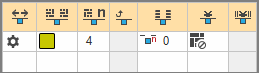
|
Group 4 : Intarsia Binding | ||
|
| ||
|
|
Conexão intarsia à esquerda |
Presetting of a binding or no binding at the left border of the color area |
|
|
Conexão intarsia à direita |
Presetting of a binding or no binding at the right border of the color area |
|
|
Direção da conexão intarsia à esquerda |
Specification for inserting the Binding module at the left border of the color area depending on the carriage direction
|
|
|
Direção da conexão intarsia à direita |
Specification for inserting the module Binding at the right border of the color are depending on the carriage direction
|
|
|
Módulo para conexão intarsia à esquerda |
Presetting of the knitting mode for binding at the left border of the color area |
|
|
Módulo para conexão intarsia à direita |
Presetting of the knitting mode for binding at the right border of the color area |
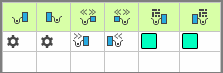


|
Group 5: Border Processing | ||
|
| ||
|
|
Escalonamento permitido sem processamento de ourelas, lado esquerdo |
Maximum number of needles when widening at the left border of the color area without automatic border processing.
|
|
|
Escalonamento permitido sem processamento de ourelas, lado direito |
Maximum number of needles when widening at the right border of the color area without automatic border processing.
|
|
|
Módulo para processamento de ourelas à esquerda |
Presetting of the knitting mode for the border processing (feeding) in case of large widenings (stepping) of the color area
|
|
|
Módulo para processamento de ourelas à direita |
Presetting of the knitting mode for the border processing (feeding) in case of large widenings (stepping) of the color area
|
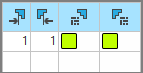
- 7
- Carry out
 Processamento
técnico if necessary.
Processamento
técnico if necessary.
: After carrying out the Processamento
técnico you are able to view and weigh up the automatic processing, if corrections / optimizations are necessary.
- 8
- Back to the
 Amostra de desenho to make pattern-related changes.
 - 9
- Open the Guia-fios tool window again for this purpose.
- 10
- Make the desired changes in the following groups:
- Group Entrar tecendo
- Control of a yarn carrier at the start of a color area
Explanation 'Knitting-in':
The yarn carrier is at the fabric selvedge and must be brought into the fabric to knit at the beginning of its color field.
- Default setting: Using Intarsia yarn carriers (swivelling)
- To knit-in the yarn carriers there are different technical modules available in the
 Knit Explorer.
 - For knitting-in the yarn carriers from the fabric selvedge, the shortest distance (way) to the color field is always used by default.: Regarding the knitting technique, many options are available.
- If there are various color areas of the same color available in the design pattern, then the yarn carrier is knitted-out at the end of the color area and then knitted-in again from its last position.
|
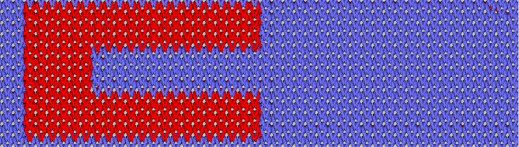
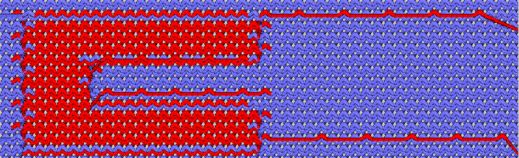
Example with the Entrar tecendo malha retida de fio flutuante, conexão de malha retida technical module | |
|
Front Side of Fabric |
Back Side of Fabric |
|
|
|
|
Result: Knitting-in and knitting-out with tuck and float is only visible on the fabric back.
| |
|
Knitting-in | ||
|
| ||
|
|
Direção de início |
Specification of the knitting direction for the first row of a color (color area) |
|
|
Número de colunas sem Entrar tecendo |
Quantity of columns (needles) without Knitting-In module |
|
|
Módulo para entrar tecendo |
Specification of the knitting mode for knitting-in
|
|
|
Largura de repetição para entrar tecendo |
Presetting of the module width in total for the knitting mode of feeding-in the yarn carrier
|
|
|
Deslocamento de fileiras para desprender |
Column appears automatically if a module for knitting-in with casting-off is used |
|
|
Fileiras de offset para entrar tecendo |
Knitting-in of the yarn carrier by x rows before the beginning of the color area
|
|
|
Nó / Conexão no início |
Presetting a module for knot / binding at start of a color area without knitting-in.
|
|
|
Offset de coluna para entrar tecendo com nó |
Move the position of a knot (module) by x columns to the left or right.
|
: The direction of knitting-in of a yarn carrier is always carried out from last position.
Direction of knitting-in yarn carriers:
The knitting-in direction of a yarn carrier is specified by the home position of the yarn carriers.
- Yarn carrier is on the left side in the clamping and cutting device -> the yarn carrier is knitted from the left to the fabric selvedge.
- Yarn carrier is on the right side in the clamping and cutting device -> the yarn carrier is knitted from the right to the fabric selvedge.
: The direction of knitting-in of a yarn carrier is always carried out from last position.
Two possibilities in the Guia-fios tool window:
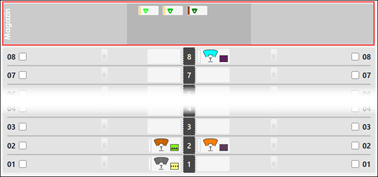
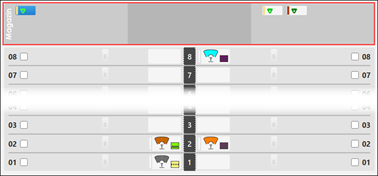
- In the magazine move the yarn carrier manually from 'undefined' to the desired side (left / right) of the magazine.
|
|
|
|
Automatic |
Manually |
|
Yarn carriers are positioned by default in the 'undefined' area in the magazine.
Result:
Rule:
|
Place the yarn carrier manually with LMB to the left or right in the magazine.
Result:
|
- Move the yarn carriers allocated to the yarn carrier rails to the desired rail side.
|
Example 1 |
Example 2 | |
|
|
| |
|
1 |
Yarn carrier on the right side of the yarn carrier rails |
Yarn carrier 3A right was manually moved to the left side.
|
|
2 |
Yarn carrier on the left side of the yarn carrier rails | |
|
| ||
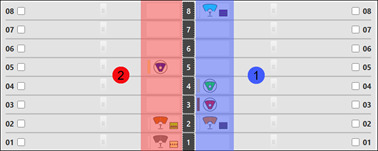
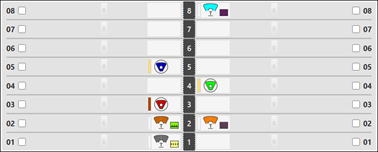
: The direction of knitting-in of a yarn carrier is always carried out from last position.
Preset in Direção de início column:
The following Intarsia process is used by default for the processing with the Processamento técnico.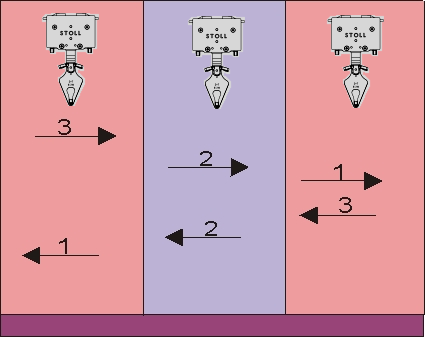
: This even processing results in a beautiful, even fabric image with the highest machine run time, which is why the yarn carriers are also grouped. This way the run time is reduced.
 Direção de início column:
- To change the knitting direction of the first stitch row of a color field: The change influences the 'even' Intarsia processing.
Preset with Número de colunas sem Entrar tecendo:
 Número de colunas sem Entrar tecendo column:
|
|
A |
Distance of the color field from the fabric selvedge in needles (columns), where no module is entered to be knit-in.
|
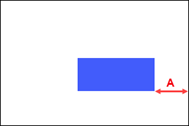
Preset in Módulo para entrar tecendo and Largura de repetição para entrar tecendo column:
- These two columns work together.
If a corresponding module is selected in the Módulo para entrar tecendo column, then the
  Largura de repetição para entrar tecendo column is active or displayed.
 - The technical module for knitting-in consists of 2 pieces of information:
- Binding
- Repetition
|
Example | |
|
| |
|
1 |
Binding |
|
2 |
Repetition |
|
|
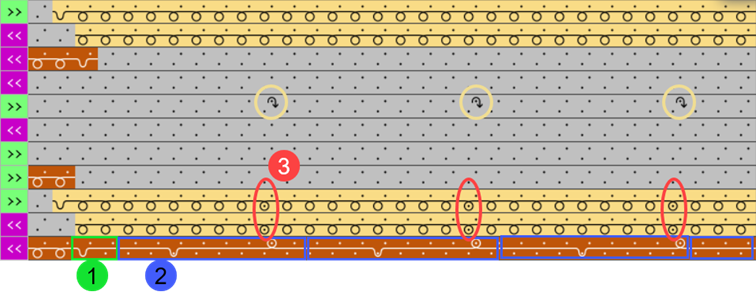
Selection of the desired technical module for the knitting-in Example: Entrar tecendo malha retida de fio flutuante, conexão de malha retida
Technical module consists of two parts:
|
|
|
Specification of the module width for the repetition, which as such is repeated up to the fabric selvedge. Example: 4 |

Preset in Deslocamento de fileiras para desprender column:
- The Largura de repetição para entrar tecendo column and the
 Deslocamento de fileiras para desprender column are active, if in the Módulo para entrar tecendo column a corresponding knitting-in module with casting-off is selected.
 - The technical module for knitting-in with casting-off consists of 3 pieces of information:
- Binding
- Repetition
- Casting-off after x pattern rows
|
Example | |
|
| |
|
1 |
Binding |
|
2 |
Repetition |
|
3 |
Number of pattern rows for the cast-off |
|
|
Selection of the desired technical module for the knitting-in Example: Malha retida e malha de desprendimento, Entrar tecendo
Technical module consists of three parts:
|
|
|
Specification of the module width for the repetition, which as such is repeated up to the fabric selvedge. Example: 8 |
|
|
Specification after how many pattern rows the tuck is to be cast-off. Default setting: 1 (pattern row) Example: 2
|
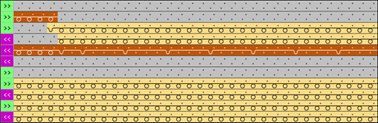
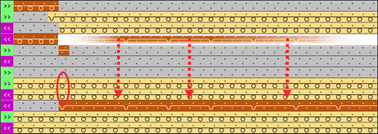
Preset in Fileiras de offset para entrar tecendo column:
 Fileiras de offset para entrar tecendo column to move the knit-in row.
|
Standard behavior when knitting-in a yarn carrier to their color field |
Use of the column
|
|
|
|
|
Yarn carriers are knit-in by default in the first knitting row of a color field. |
Example: 2 pattern rows The yarn carrier is knit-in 2 pattern rows before the start of the color field.
|
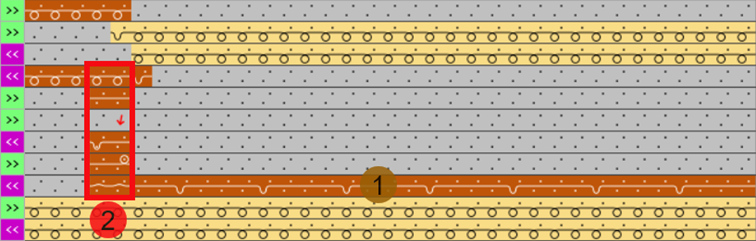
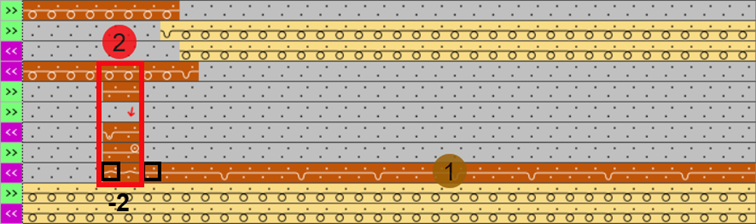
Preset in Nó / Conexão no início and Offset de coluna para entrar tecendo com nó column:
These two columns work together, which means that if a corresponding module is selected in the  Nó / Conexão no início column, then the
  Offset de coluna para entrar tecendo com nó column is active or displayed.
|
Example without column offset (default) | ||
|
| ||
|
1 |
|
Module for the knitting-in |
|
2 |
|
Selection e.g. of the Nó, Malha retida, Início, Entrar tecendo module |
|
|
No entry in this Offset de coluna para entrar tecendo com nó column | |
|
| ||
|
Example with column offset | ||
|
| ||
|
1 |
|
Module for the knitting-in |
|
2 |
|
Selection of the Nó, Malha retida, Início, Entrar tecendo module |
|
|
Entry of a value in this Offset de coluna para entrar tecendo com nó column Example: -2 | |
- Group Sair tecendo
- Control of a yarn carrier at the end of a color area
Explanation 'Knitting-out':
At the end of a color area, the yarn carrier is brought from the fabric to the fabric selvedge (knitted-out).
- To knit-out the yarn carriers there are different technical modules available in the Knit Explorer.
- The knitting-out (direction) of the yarn carriers is entered into the pattern according to the following points:
- Pattern structure
- Even Intarsia procedure
- Yarn carrier positions
|
Example with the Sair tecendo malha retida de fio flutuante, conexão de malha retida technical module | |
|
Front Side of Fabric |
Back Side of Fabric |
|
|
|
|
Result: Knitting-in and knitting-out with tuck and float is only visible on the fabric back.
| |
|
Knitting-out | ||
|
| ||
|
|
Direção de saída da tricotagem |
Preset of the direction for knitting-out of the yarn carrier at the end of a color area |
|
|
Número de fileiras para sair tecendo |
Preset of the distance of color areas from which on knitting-out starts. |
|
|
Módulo para sair tecendo |
Preset of the knitting mode (module) for knitting-out
|
|
|
Largura de repetição para sair tecendo |
Presetting of the module width in total for the knitting mode of feeding-in the yarn carrier
|
|
|
Deslocamento de fileiras para desprender |
Column appears automatically if a module for knitting-out with casting-off is used |
|
|
Offset de fileira para sair tecendo |
Knitting-out of the yarn carrier by x rows after the end of the color area
|
|
|
Nó / Conexão no final |
Presetting a module for knot / binding at end of a color area.
|
|
|
Offset de coluna para sair tecendo com nó |
Move the position of a knot (module) by x columns to the left or right.
|
Preset in Direção de saída da tricotagem column:
: With the Processamento
técnico, the yarn carriers are calculated and knitted-out automatically according to the pattern.
-
 Direção de saída da tricotagem column, to manually influence the automatic calculation of the knitting-out.
: The manual change of the direction of the knitting-out of a color field influences the processing of the following pattern rows in the basic pattern.
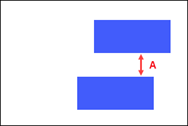
Preset with Número de fileiras para sair tecendo:
 Quantity of pattern rows for knitting-out, SEN edge and clamping
column in group 1 - General
Quantity of pattern rows for knitting-out, SEN edge and clamping
column in group 1 - General
|
|
A |
Preset of a distance between two color fields of a yarn carrier in pattern rows Default setting (A) 3 (pattern rows) Result:
|
Preset in Módulo para sair tecendo and Largura de repetição para sair tecendo column:
- These two columns work together.
If a corresponding module is selected in the Módulo para sair tecendo column, then the
  Largura de repetição para sair tecendo column is active or displayed.
 - The technical module for knitting-out consists of 2 pieces of information:
- Binding
- Repetition
|
| |
|
|
Selection of the desired technical module for the knitting-out
Technical module consists of two parts:
|
|
|
Specification of the module width for the repetition, which as such is repeated up to the fabric selvedge. |
Preset in Deslocamento de fileiras para desprender column when knitting-out:
- The Largura de repetição para sair tecendo column and the
 Deslocamento de fileiras para desprender column are active, if in the Módulo para sair tecendo column a corresponding knitting-out module with casting-off is selected.
 - The technical module for knitting-out with casting-off consists of 3 pieces of information:
- Binding
- Repetition
- Casting-off after x pattern rows
|
| |
|
|
Selection of the desired technical module for the knitting-out Example: Malha retida e malha de desprendimento, Sair tecendo
Technical module consists of three parts:
|
|
|
Specification of the module width for the repetition, which as such is repeated up to the fabric selvedge. Example: 8 |
|
|
Specification after how many pattern rows is to be cast-off. Default setting: 1 (pattern row) Example: 2
|
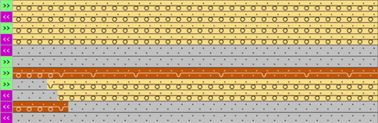
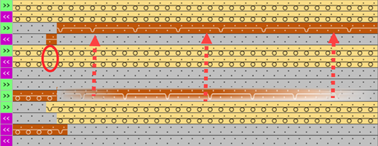
Preset in Offset de fileira para sair tecendo column:
 Offset de fileira para sair tecendo column to move the knit-out row.
|
Standard behavior when knitting-out a yarn carrier from their color field |
Use of the column
|
|
|
|
|
Yarn carriers are knit-out by default in the last knitting row of a color field. |
Example: 2 pattern rows The yarn carrier is knit-out 2 pattern rows after the end of the color field.
|
Preset in Nó / Conexão no final and Offset de coluna para sair tecendo com nó column:
These two columns work together, which means that if a corresponding module is selected in the  Nó / Conexão no final column, then the
  Offset de coluna para sair tecendo com nó column is active or displayed.
|
Example without column offset (default) | ||
|
| ||
|
12 |
|
Module for Knitting-out |
|
2 |
|
Selection of the Nó, Malha retida, final module |
|
|
No entry in the Offset de coluna para sair tecendo com nó | |
|
| ||
|
Example with column offset | ||
|
| ||
|
13 |
|
Module for Knitting-out |
|
2 |
|
Selection of the Nó, Malha retida, final module |
|
|
Entry of a value in the Offset de coluna para sair tecendo com nó column Example: -2 | |
- Group Conexão intarsia
- Connection between two neighboring color areas
Explanation 'Intarsia Binding':
Two neighboring knitting areas (color areas) are connected with each other, with the help of the 'Intarsia Binding'.
- For the Intarsia binding there are different technical modules available in the Knit Explorer.
- Each color area has a left border and a right border, that can be edited independently from one another.
- The Intarsia binding is entered corresponding to the carriage direction.
|
Intarsia Binding | ||
|
| ||
|
|
Conexão intarsia à esquerda |
Presetting of a binding or no binding at the left border of the color area |
|
|
Conexão intarsia à direita |
Presetting of a binding or no binding at the right border of the color area |
|
|
Direção da conexão intarsia à esquerda |
Specification for inserting the Binding module at the left border of the color area depending on the carriage direction
|
|
|
Direção da conexão intarsia à direita |
Specification for inserting the module Binding at the right border of the color are depending on the carriage direction
|
|
|
Módulo para conexão intarsia à esquerda |
Presetting of the knitting mode for binding at the left border of the color area |
|
|
Módulo para conexão intarsia à direita |
Presetting of the knitting mode for binding at the right border of the color area |
'Intarsia Binding at the Left' for the left selvedge of a color field:
Connection at the left selvedge of a color field to their neighboring left color field. Each color field is connected with the neighboring color field. This results in a closed selvedge between the two color fields.
: By default, all color fields are automatically ( ) connected with the Malha retida à frente, conexão Intarsia module.
Use of the  Conexão intarsia à esquerda column to make the following settings:
-
 Conexão ON : a Intarsia binding at the left of the color field edge will be entered
 -
 Conexão OFF : no Intarsia binding at the left of the color field edge will be entered
 -
Automático : Default Setting
-
 Predefinição : Resetting to default (see preset in the 2nd row 'D' of the color parameters table)
|
|
At the left selvedge of the color field ((2)) a Intarsia binding is entered. |
|
|
NO Intarsia binding is entered at the left selvedge of the color field ((2)). |
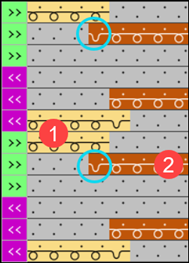
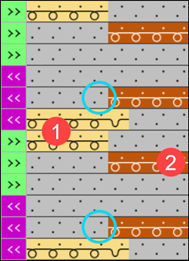
'Intarsia Binding at the Right' for the right selvedge of a color field:
Connection at the right selvedge of a color field to their neighboring right color field. Each color field is connected with the neighboring color field. This results in a closed selvedge between the two color fields.
: By default, all color fields are automatically () connected with the Malha retida à frente, conexão Intarsia module.
Use of the  Conexão intarsia à direita column to make the following settings:
-
 Conexão ON : a Intarsia binding at the right will be entered
 -
 Conexão OFF : no Intarsia binding at the right will be entered
 -
Automático : Default Setting
-
Predefinição : Resetting to default (see preset in the 2nd row 'D' of the color parameters table)
|
|
At the right selvedge of the color field ((1)) a Intarsia binding is entered. | |
|
|
At the right selvedge of the color field ((1)) NO Intarsia binding is entered. | |
|
| ||
|
Example: NO Intarsia binding between two color fields | ||
|
|
| |
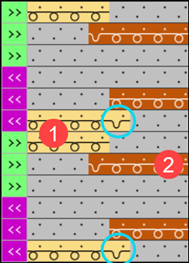
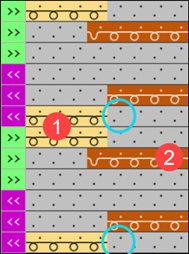
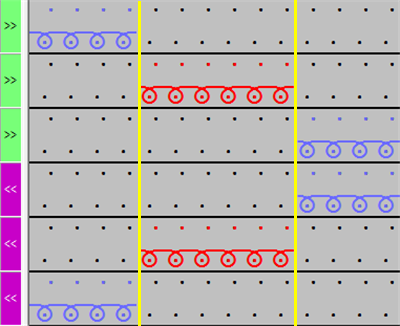
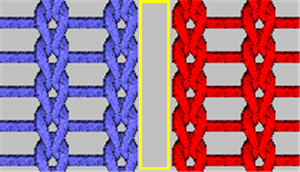
Direção da conexão intarsia à esquerda for the left selvedge of a color field:
The module for the Intarsia binding is entered depending on the carriage stroke.
- Enter module according to the carriage direction at the start of a knitting row
- - or -
- Enter module according to the carriage stroke direction at the end of a knitting row
|
| ||
|
|
Conexão ao entrar tecendo |
Default Setting |
| ||
|
|
Conexão ao sair tecendo |
|
| ||
|
|
Predefinição |
Resetting to default (see preset in the 2nd row 'D' of the color parameters table) |
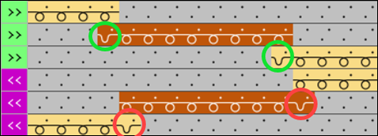
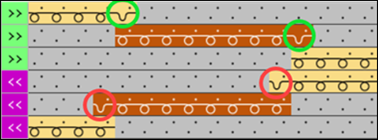
'Direction of the Intarsia Binding at the Right' for the right selvedge of a color field:
The module for the Intarsia binding is entered depending on the carriage stroke.
- Enter module according to the carriage direction at the start of a knitting row
- - or -
- Enter module according to the carriage stroke direction at the end of a knitting row
|
| ||
|
|
Conexão ao sair tecendo |
|
| ||
|
|
Conexão ao entrar tecendo |
Default Setting |
| ||
|
|
Predefinição |
Resetting to default (see preset in the 2nd row 'D' of the color parameters table) |
Preset in 'Module for Intarsia Binding at the Left' and 'Module for Intarsia Binding at the Right' column:
- For the Intarsia binding there are different technical modules available in the Knit Explorer.
- Binding with tuck
- Binding with stitch
- No binding (= vertical opening)
- Column
 Módulo para conexão intarsia à esquerda:
Selection of the module to be used at the left border of the color field -
 Módulo para conexão intarsia à direita column.
Selection of the module to be used at the right border of the color field - Variable module allocation at the left and right color field border
: Combination possibilities of the different bindings:
There are many options how the types of bindings at the color field selvedges
can be combined, where the right and left color field selvedge may also
differ from one another.
|
Example: Module Malha retida à frente, conexão Intarsia (Standard) | |
|
|
|
|
| |
|
Example: Module Malha à frente, conexão intarsia | |
|
|
|
|
|
Front Side of Fabric |
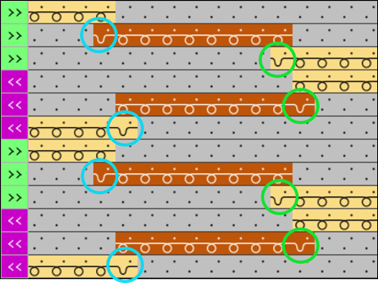
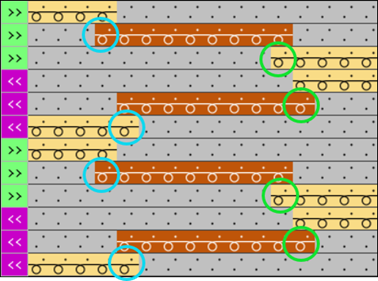
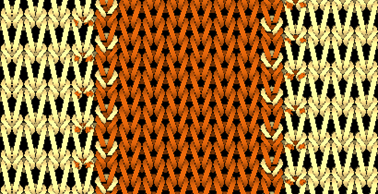
- Group Processamento de ourelas
- Control (positioning) of the yarn carrier at the border of a color area
Explanation 'Border Processing':
The concept 'Border processing' describes the processing of the steps at the left / right border of a color area (edge) depending on the carriage stroke direction. The yarn carrier is positioned according to the shape for the following knitting row, with the help of the border processing.
- For the Processamento de ourelas there are different technical modules available in the Knit Explorer.
-
Feed:
The concept 'Feed' describes the positioning of a yarn carrier regarding the following knitting row of its own color field. For this, there are different options regarding the knitting technique. - Each color area can be edited differently at the left / at the right.
- The modules are entered according to the carriage direction.
|
Group: Border Processing | ||
|
| ||
|
|
Escalonamento permitido sem processamento de ourelas, lado esquerdo |
Maximum number of needles when widening at the left border of the color area without automatic border processing.
|
|
|
Escalonamento permitido sem processamento de ourelas, lado direito |
Maximum number of needles when widening at the right border of the color area without automatic border processing.
|
|
|
Módulo para processamento de ourelas à esquerda |
Presetting of the knitting mode for the border processing (feeding) in case of large widenings (stepping) of the color area
|
|
|
Módulo para processamento de ourelas à direita |
Presetting of the knitting mode for the border processing (feeding) in case of large widenings (stepping) of the color area
|
Escalonamento permitido sem processamento de ourelas, lado esquerdo and Escalonamento permitido sem processamento de ourelas, lado direito for the borders of a color field:
'Allowed stepping' describes the number of needles, where the module for the border processing is not entered.
: Default value with 'allowed stepping' at the left and right is 1 needle.
-
 Escalonamento permitido sem processamento de ourelas, lado esquerdo
 -
 Escalonamento permitido sem processamento de ourelas, lado direito
|
Examples
| |
|
|
Allowed stepping: 1 needle (standard) |
|
|
Allowed stepping: 2 needles |
|
|
Allowed stepping: ≥ 3 needles
The yarn carrier is kicked and then with the module for knitting-in is fed to the following knitting row. |
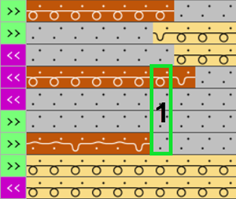
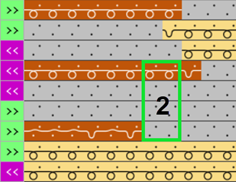
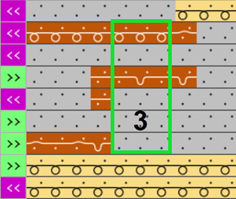
Selection Módulo para processamento de ourelas à esquerda and Módulo para processamento de ourelas à direita for the borders of a color field:
For the border processing of a color area there are different knitting techniques available as technical modules.
: The Malha retida, --v--, Processamento de ourelas technical module is used by default.
-
 Módulo para processamento de ourelas à esquerda
 -
 Módulo para processamento de ourelas à direita
|
Examples for Módulo para processamento de ourelas à direita | |
|
| |
|
14 |
Border processing in the carriage stroke from right to left
|
|
2 |
Border processing in the carriage stroke from left to right
|
|
|
Black marking = Intarsia binding |

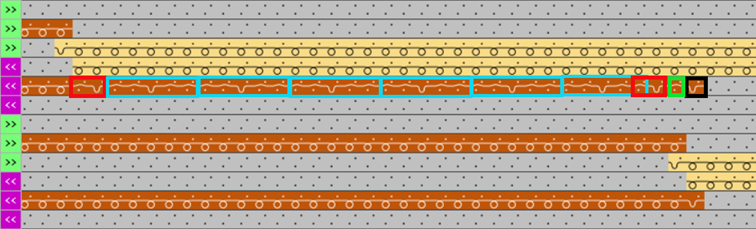
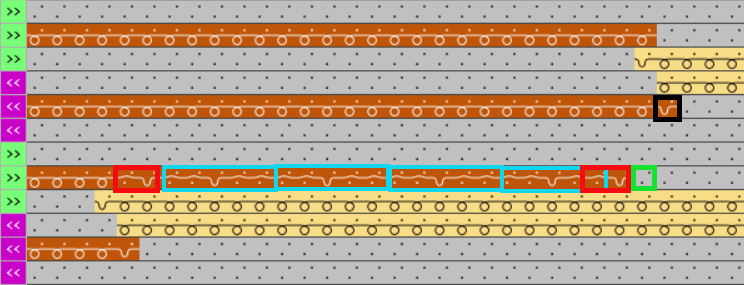
|
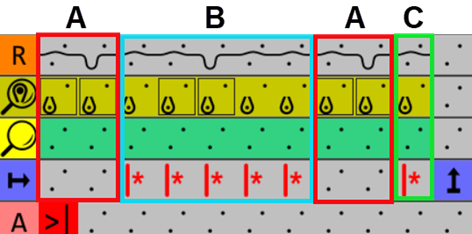
About the procedure based on the technical module for border processing at the right Malha retida, --v--, Processamento de ourelas | |
|
| |
|
A |
The information is entered 1 time each at the start and end of the knitting row |
|
B |
The information is entered x times according to the step width.
|
|
C |
The information is entered x times according to the preset under Allowed stepping without border processing at the right. |
- 11
-
Start Technical Processing:
-
 Show symbol view after technical processing, to check the changes.
- 12
- Generate
 Sintral.
 - 13
- Start the
 Controle Sintral.
 - 14
-
 Extrair the knitting program.
 - A program for the knitting machine will be created: CMS530. Exercise_Pattern.zip.
- Load knitting program into the machine.
 : The extracted file "CMS530.Exercise_Pattern.zip" can be loaded onto the machine with an USB stick or via Ethernet.