What was new in CREATE PLUS V2.6
Release V2.6. 11/2023
Versão de arquivo: 14 (V2.6)
Compatible with:
- EKC 3.0
- CKC 2.0
- OKC 6.6
Detect Knitting-in to Opposite Side Automatically in Configuração / Outras configurações
-
 Detect Knitting-in to Opposite Side Automatically
 - Default for tandem with comb
- Default for machines with clamping at the right only
- Setting applies always to all yarn carriers
- Tricotagem de várias peças
- Yarn carriers of the right fabric piece are at YG right
- Yarn carriers of the left fabric piece are at YG left
- Alternating binding-off of left and right fabric piece.
You can toggle the display of the stitch lengths within Sintral.
Call up the Arquivo tab -> Opções dialog box.
Option of the  Opções dialog box, Project Settings sections:
|
|
All the NP values used in the pattern are displayed as comment within the Sintral. |
|
|
The NP values are not displayed as comment within Sintral. |


Move the yarn carriers for the right carriage in tandem mode
With the tandem mode enabled on the machine, you can modify the yarn carrier allocation of the right carriage independently to left carriage.
- 221
- Call up the Tandem (YLR) tab in the Guia-fios tool window.
- 222
- Click the right carriage.
- 223
- Click the button at the right or left of the yarn carrier home positions and drag the whole yarn carrier track to the desired position.
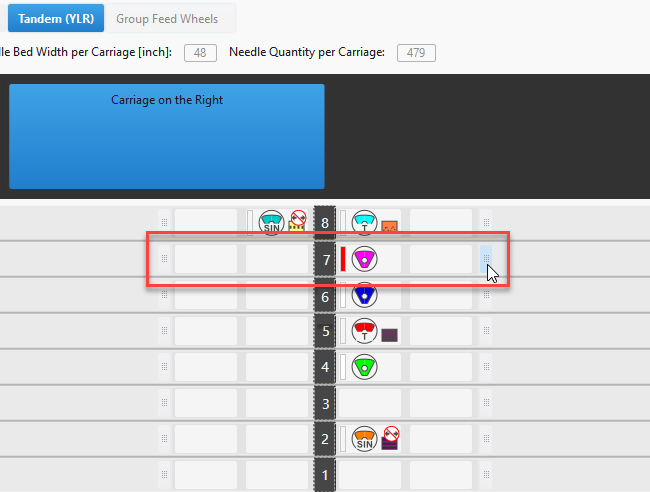
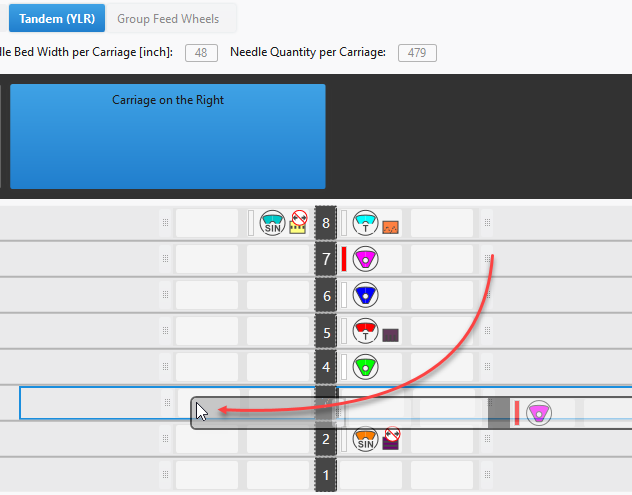
Do Not Combine Yarn Carriers
New option in the Outras configurações tab of the Configuração dialog box under Agrupar guia-fios:
 Do not combine.
Each yarn carrier of intarsia sequences is knitted by a separate system within the whole pattern.
Detect Knitting-in to Opposite Side Automatically
- You can specify for each yarn carrier to be knitted-in to the opposite side by the Entrar tecendo no lado oposto option of the Guia-fios tool window.
- Now the Detect Knitting-in to Opposite Side Automatically option is available.
- Configuração -> Outras configurações
- For each yarn carrier, the knitting-in to the opposite side will be determined automatically.
- The yarn carriers which will be used closer the opposite side of the home position will be knitted-in before the start to the opposite side.
- The Entrar tecendo no lado oposto function in the Guia-fios tool window will get disabled.
- More
Start modules of the 1x1 Técnica de desprendimento type
New start modules of the 1x1 Técnica de desprendimento knitting technique are available in the Knit Explorer under the path of the same name.
You will find these modules under Começos / 1x1 Técnica de desprendimento:
- Começo, 1x1, Técnica de desprendimento 1x1
- Começo, 1x1, técnica de desprendimento 1x1, finura grossa
- Começo, 2x1, Técnica de desprendimento 1x1
- Começo, 2x1, técnica de desprendimento 1x1, finura grossa
- Começo, 2x2, Técnica de desprendimento 1x1
- Começo, 2x2, técnica de desprendimento 1x1, finura grossa
- Começo, tubular, técnica de desprendimento 1x1
- Começo, tubular, técnica de desprendimento 1x1, finura grossa
Saving the patterns of a pattern project individually.
In the Amostra tool window, you will find the Export Pattern... function in the context menu of a pattern.
- A new pattern project will be created.
- The pattern you clicked will be saved within this pattern project.
- Context menu on the pattern name
CMS W - New Weft Yarn Carrier Qt
Another type of weft yarn carrier available for the CMS W machines:
|
Up to now |
Qw yarn carrier One weft yarn carrier can be used per system. |
|
|
New |
Qt yarn carrier Up to three weft yarn carriers can be used per system. |
|
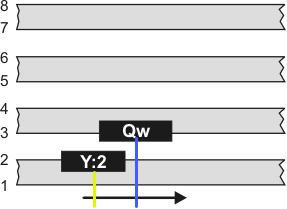
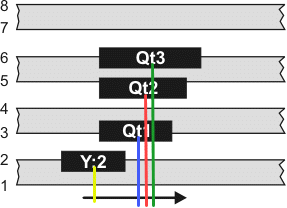
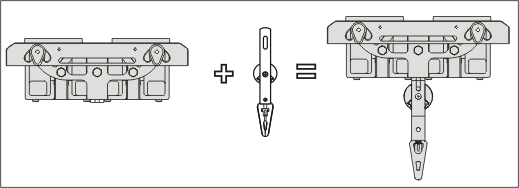
There are three versions of the Qt weft yarn carrier:
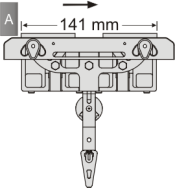
- Qt1 – 141 mm (ID 4170 282 857)
- Qt2 – 161 mm (ID 4170 282 858)
- Qt3 – 181 mm (ID 4170 282 859)
The yarn carrier plunger (A) drives of the yarn carrier carriage at the outside and pushes the yarn carrier ahead.
Advantage:
- No additional system is required for the weft yarn.
- One system only inserts the weft yarn and encloses it.
|
Working with Qt |
One system only inserts the weft yarn and encloses it (S2).
|
|
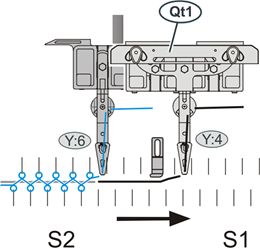
 The yarn carriers must be on different tracks.
Notes:
- Height of the Qt yarn carrier = Height of a normal yarn carrier
- The yarn carrier bow is taken from the corresponding normal yarn carrier.
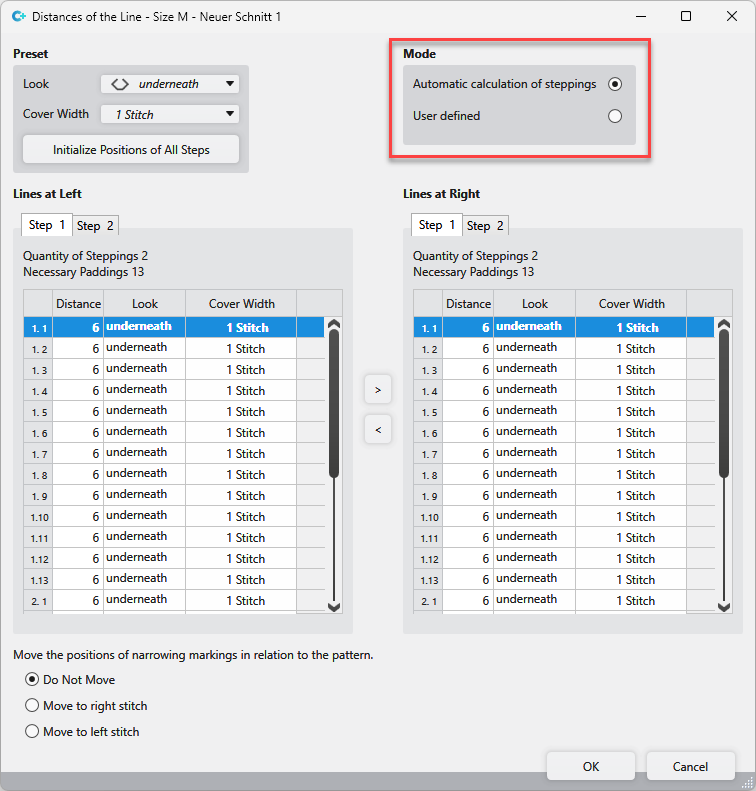
New feature for the Fair Isle stepping kind.
Now you can select the calculation of the steppings in the Distâncias da linha tool window:
- Cálculo automático dos passos
- - or -
- Personalizado
- Multi-step Narrowing
Dimensioned Shape - Deleting Several Sizes at Once
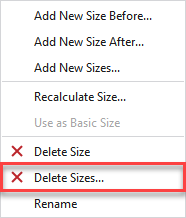
You will find the Delete Sizes... function in the context menu of the status bar of the Dimensioned Shape.
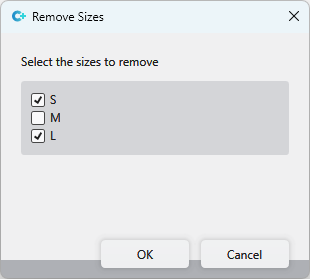
Select the sizes to be removed in the Delete Sizes dialog box.
Cancel Selection in the Start Ribbon
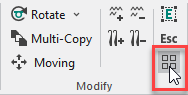
You can call-up the  Cancelar seleção
function directly in the Alterar group of the Início tab.
Cancelar seleção
function directly in the Alterar group of the Início tab.
New functions of the Localizar e substituir dialog box
- The cursor attributes will be applied to the Procurar and the Substituir area by calling-up the dialog box.
-
Delete All function at the top right of the dialog box
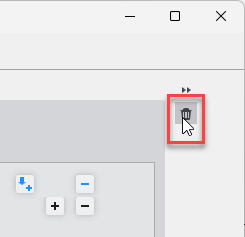
All data input will be removed from the dialog box. - Find and Replace
Symbols for deleting within the Knitting Element Editor.
The symbols for deleting are all available in the top row of the Knitting Element Editor.
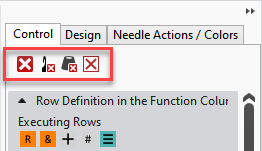
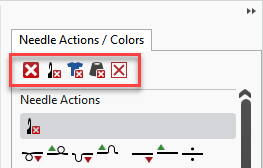
Applies to the following tool windows and tabs:
- Ações da agulha
- Símbolos de forma
- Cores da amostra
- Controle
- Desenho
- CA
Renaming Multiple Knitting Elements Simultaneously
You can select and rename multiple knitting elements at the same in the Módulos, CA, MA and Partes de amostra tool windows.
- 224
- Select the knitting elements.
- 225
- Call up Rename Multiple Items... function of the context menu.
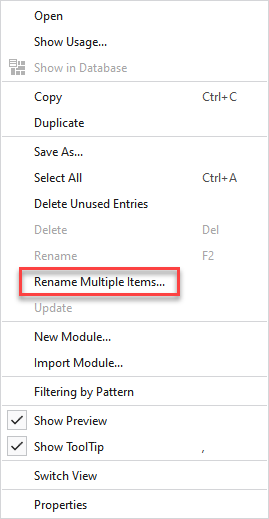
- The Rename Multiple Items dialog box appears.
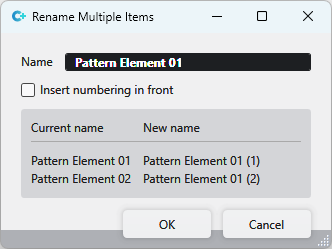
Make the following settings in this dialog box:
|
Name |
Enter the new and common name for the knitting elements. |
|
|
The numbering appears in front of the name. |
|
|
The numbering follows the name. |
|
Display |
The current and the new names of the knitting elements are shown in the lower part of the dialog box. |
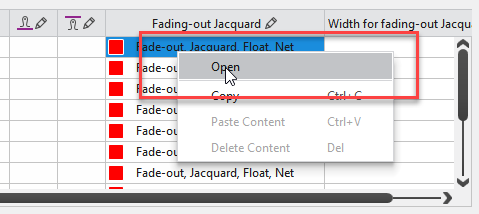
Open a module inserted in a table.
Now you can open modules inserted in a table via the context menu.
Within shape edges for examples:
Recolor a multicolored pattern element:
You can change the colors of a multicolored pattern element as desired before you draw with the pattern element.
With selecting the pattern element, an arrow appears next to the pattern color in the cursor attributes.
You can open the presentation of the colors of a pattern element by this arrow.
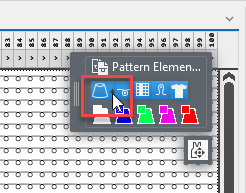
- 226
- Click a color of the Cores da amostra which you want to insert.
- 227
- Click the color of the pattern element which you want to replace.
- 228
- Repeat this procedure with all colors which you want to replace.
- 229
- Delete the color selected at last from the cursor attributes.
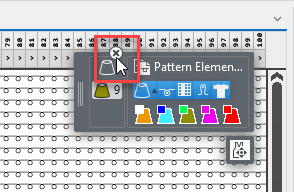
- 230
- Insert the pattern element with the new color combination into the pattern.
New Function: Move Raster Shape Part
You will find the Mover forma de retícula function under the display of the cursor attributes.
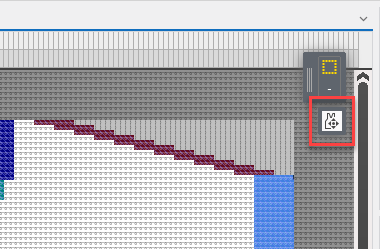
- The function is only available if no shape is positioned on the pattern.
- Click on the Mover forma de retícula function to select the raster-shape.
- Move the raster-shape to the desired position with the mouse button pressed on the selection.
- Then click Mover forma de retícula again to cancel the selection.
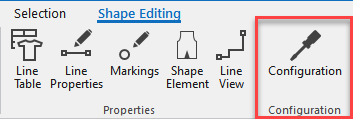
Call-up Shape Configuration Directly
You can open the Todos os cortes tab of the Configuration dialog box directly in the Edição de corte tab of the lined shape layer.
New Dialog Box for Multiple Processing
You start the joint technical processing and creation of the knitting programs exclusively in Multiple Processing dialog box.
Call up the dialog box in the Início tab next to the Sintral group.

Therefore, the Processamento múltiplo tab is completely eliminated.
Make the following settings in the Multiple Processing dialog box:
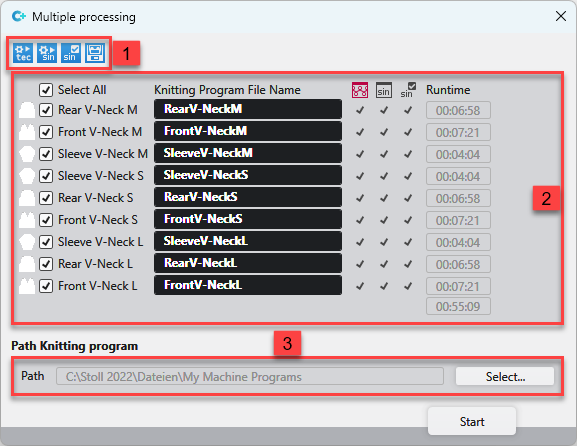
|
1 |
Select the steps of processing you want to be done. You can click only the patterns which are ready for this selection. |
|
2 |
Select the patterns that you want to get processed. You can edit the file name of the knitting programs. The knitting time appears after the Sintral Check at right of the pattern. |
|
3 |
Enter the path where the knitting programs shall be saved. |
Additional tabs of Pattern Parameters .
In connection with the STOLL Template Editor , the following tool windows are integrated into the Pattern Parameters :
- Sintral
- Ativação de funções (F:)
- Instrução de Sintral / PRINT
- Sintral Functions
- Stitch Density
- Colors
These tool windows are therefore exported together with the Setup Data Template .
Pattern Parameters and configuration data of a pattern project can be saved as a template, edited and used in a new pattern project.
Exportar
From an existing pattern project, setup data and the configuration can be exported as a template file.
Buttons of the Backstage View / Exportar :
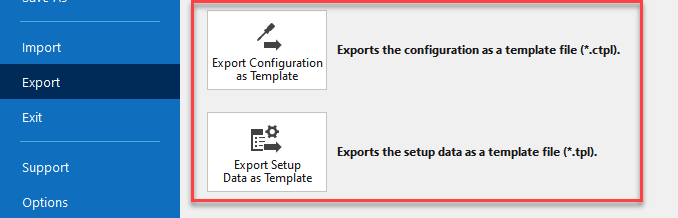
|
Export Configuration |
Saves the configuration data as a template (*.ctpl).
Default path: |
|
Export Pattern Parameters as Template |
Saves the pattern parameters as a template (*.tpl). |
STOLL Template Editor
Open the STOLL Template Editor on the Página de início.
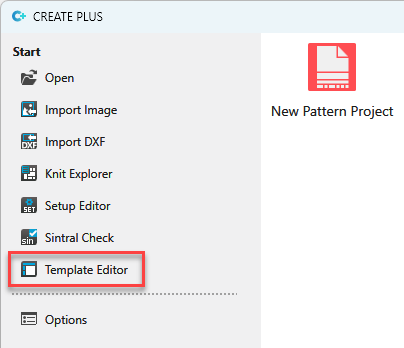
You can load, edit and save template files.
 Only project relevant data will be saved in the setup file.
This affects both the configuration and the setup data.
Use Setup Data Templates for New Projects in a pattern:
- 231
- Open the Geral section of the Opções dialog box via the Backstage View.
- 232
- Load a Fully Fashion Template under Setup Data Templates for New Projects.
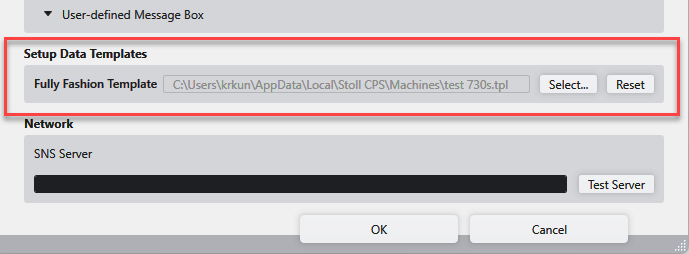
- This template will be used by every new pattern project.
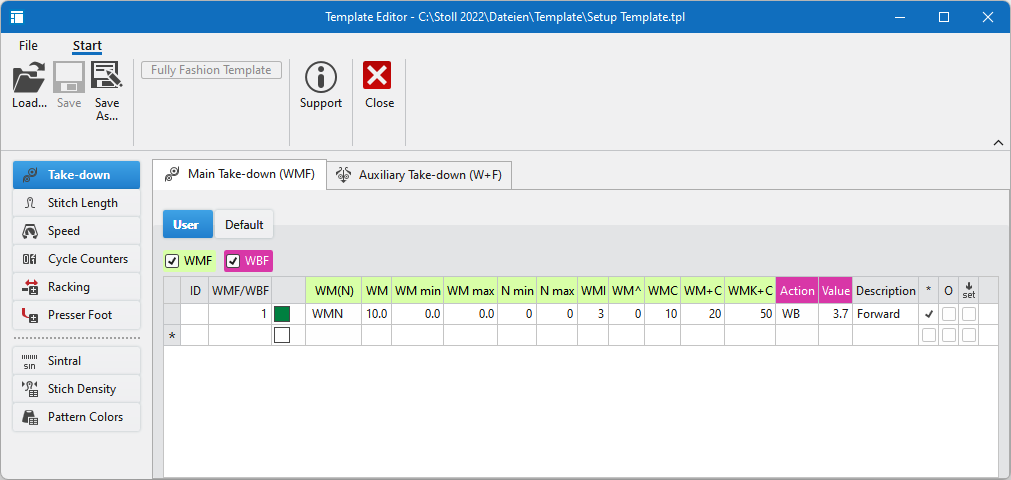
- The G ( √ = Entrada é salva globalmente para projectos seguintes. ) column is omitted.
Use configuration templates in in a pattern.
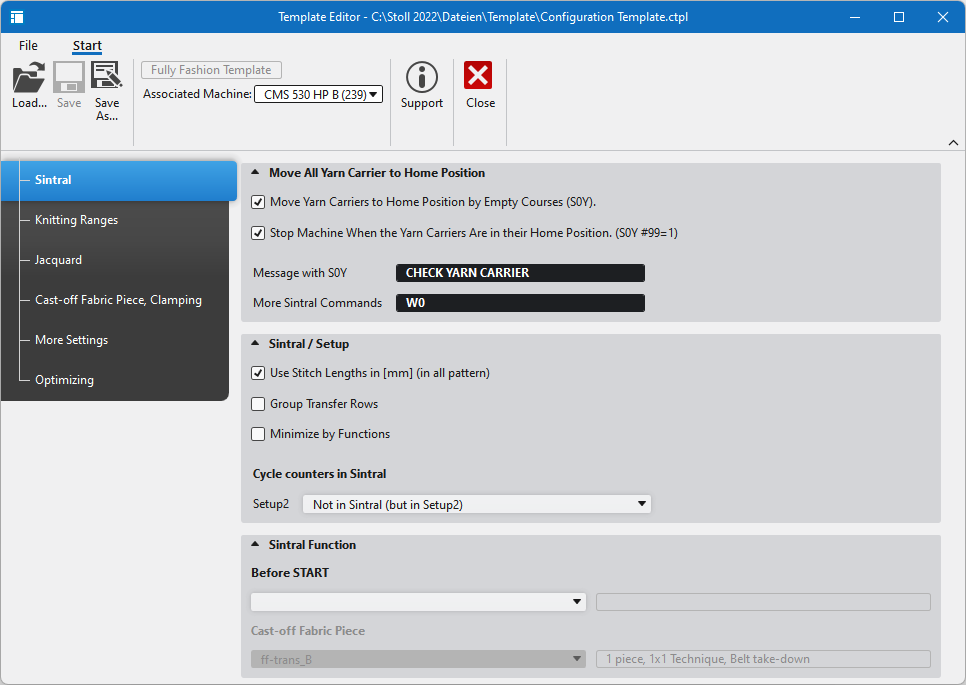
You assign configuration templates to your own machines in the Selecionar máquina dialog box.
- The configuration template must be saved in the same folder as your own machine.
Default path:
C:\Users\[username]\AppData\Local\Stoll [CPS|CDESIGN|CLITE]\Machines
- 233
- Create a private machine in the Selecionar máquina dialog box.
- 234
- Open the Propriedades da máquina dialog box via the context menu of this machine.
- 235
- Load the Fully Fashion Template under Geral of the properties.
- The data of the corresponding configuration template will always be used for this machine then.
Statistics Dialog Box
You will find the statistical evaluations of the settings and the knitting elements of a pattern project in the Statistics dialog box.
You open the dialog box by the context menu.
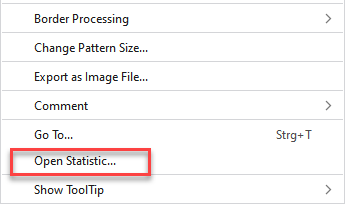
The Statistics dialog box can be opened within the following realms:
- All layers of the pattern editing except the lined shape and the dimensioned shape.
- All knitting elements
Make the following settings in the Statistics dialog box:
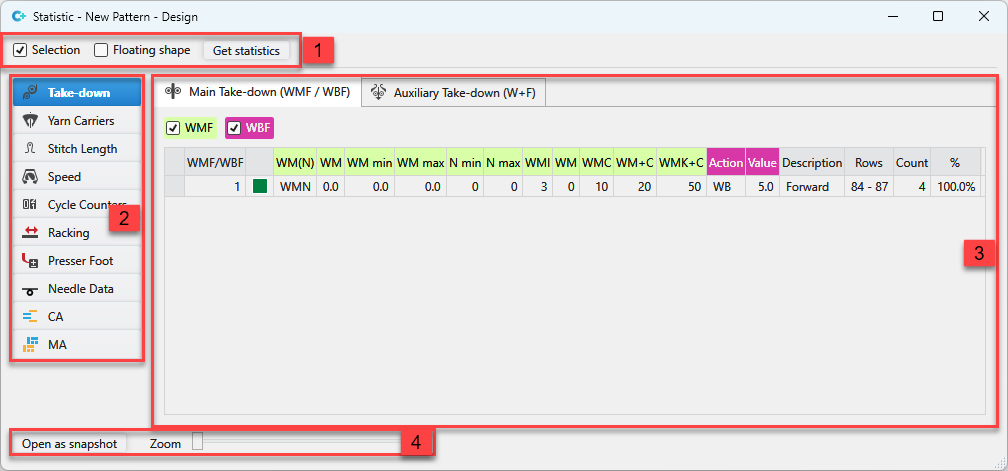
|
1 |
Define the scope and recalculate the statistical data. |
|
2 |
Select the data that is to be displayed. |
|
3 |
Joint display of the entries and the statistical evaluation |
|
4 |
Open a second view and make zoom settings. |