Draw basic pattern and define plating colors
I. Draw motif and define plating colors
- 1
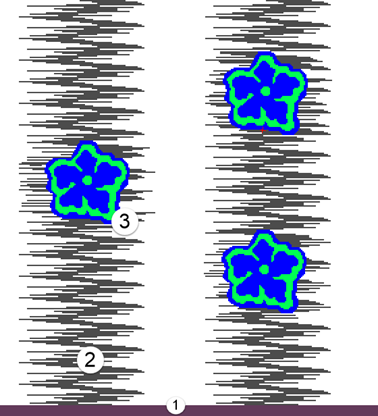
- In the basic pattern draw-in the desired motif with further yarn colors:
- Exchange yarn color #31 to yarn color #1
- Yarn color #2 for the area of Stoll-Ikat-plating
- Yarn color #3 and #4 for the area of inverse plating
|
| |
1 | 1x1 Start |
2 | Area of Stoll-Ikat-plating® |
3 | Area of inverse plating |
- 2
- Open the Plating dialog box with
 .
.
The in the Configuration / Further Setting dialog box are used to create new plating colors.
The i marking will automatically be applied to the new colors by selecting  Stoll-ikat plating®.
- 3
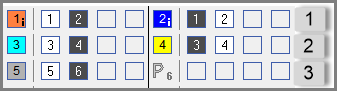
- Create the following plating colors:
- 2 plating colors for the area of Stoll-ikat plating® with the i marking.
- 2 plating colors for the area of inverse plating without marking
- 1 plating color for the start without marking
|
No. | Plating Colors | Use |
|---|---|---|
1 | P1 (orange) | Combination plating colors for the area of Stoll-ikat plating®
|
P2 (blue) | ||
2 | P3 (light blue) | Combination of plating colors for the area of inverse plating |
P4 (yellow) | ||
3 | P5 (grey) | Plating color for the start |
 : When creating the plating colors for Stoll-ikat plating ® you have to allocate type (i) to the plating color.
- 4
- Right click on the corresponding plating color.
- 5
- Select the item of the context menu.
- The plating color is indicated by the i symbol.
All plating colors will get the i marking if Stoll-ikat plating® is activated in / / Further Settings tab.
Meaning, that you have to cancel the marking of the colors for inverse plating.
- 6
- Right click the corresponding yarn color of a plating color combination.
- 7
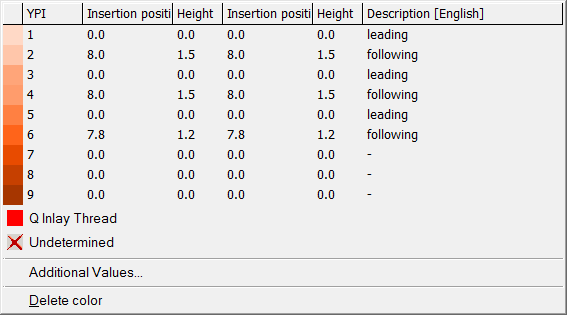
- Select the desired YPI index from the table and allocate it.
|
No. | YPI Index |
|
|---|---|---|
1 | YPI 1 + YPI 2 |
|
2 | YPI 3 + YPI 4 | |
3 | YPI 5 + YPI 6 |
- 8
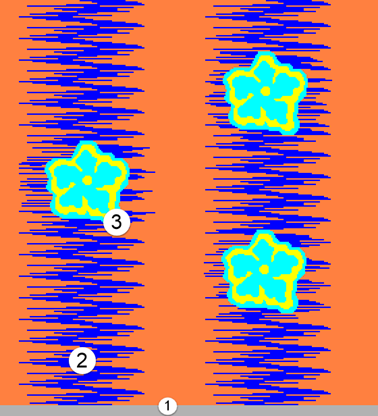
- Exchange the yarn colors in the basic pattern with the corresponding plating colors via the
 drawing tool
|
| |
1 | Plating color P5 |
2 | Plating color P1 + P2 |
3 | Plating color P3 + P4 |
Stoll-ikat plating ®
Con el así llamado Stoll-ikat plating®, para cada cambio de color se necesitan dos colores de vanisado en un sistema (= una combinación de colores de vanisado) por pasada de muestra.
Con Stoll-ikat plating® es posible utilizar una combinación de colores de vanisado diferente en cada sistema.
Está permitido un máximo de 30 cambios de posición en una pasada de muestra donde se deberá respetar una distancia entre cambios de color de 2 pulgadas (con 1.0 m/s).