What's new in CREATE PLUS?

https://software.stoll.com/createplus/software_updates/index.html
Release V2.10 07/2025
文件版本: 18 (V2.10)
Compatible with:
- EKC 3.1
- CKC 2.1
- OKC 6.6
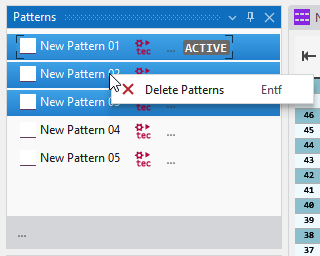
Exporting Directories of the 编织资源管理器
You will find the  Export Folder Structure function in the 目录 group of the 起头 ribbon.
Effect:
- Exports the selected directory of the 编织资源管理器.
- Exports all the subdirectories with all the contained knitting elements.
- Directories (group)
Import Sintral 检验
You can import saved Sintral 检验 data (*.simx) as a pattern.
As a new Pattern Project:
- 157
- In the Backstage view or the start window, call up the 打开 function and select the Sintral 检验 file type (*.simx).
- 158
- Enter the file path and select the corresponding file.
- A new pattern project will be created and the Sintral 检验 will get open as a new pattern.
Or as a new pattern within an existing project:
- 159
- In the Pattern tool window of a project, call-up the 导入花型 function of the context menu.
- 160
- Select file type Sintral 检验 (*.simx), enter the path and select the corresponding file.
- The Sintral 检验 will be created in the pattern project as a new pattern.
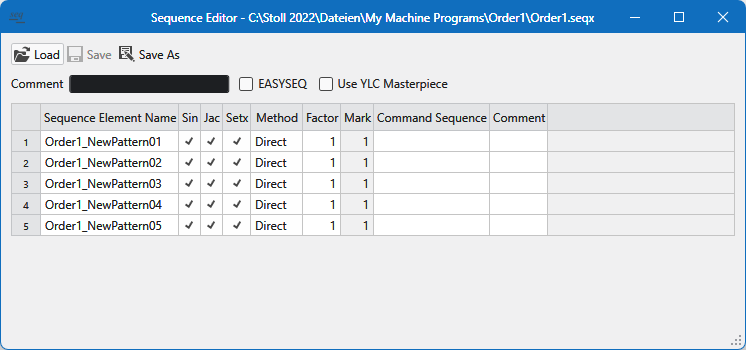
Reworked Sequence Editor
- You can call-up
 Sequence Editor on the Start Window.
 - The presentation of the editor has been improved.
- Features and settings of the editor have been retained.
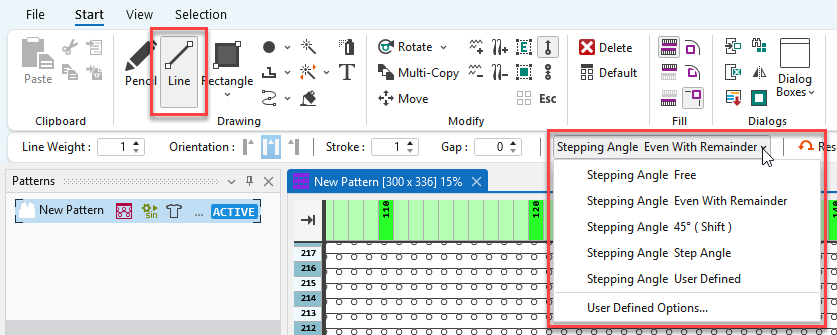
Enhanced Drawing Tool Line
Two new options for the 线 drawing tool:
- Even With Remainder
- 用户自定义
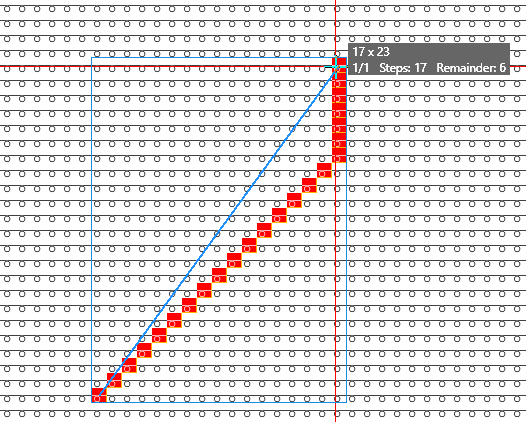
Even With Remainder
The line is drawn with an even slope and the rest is filled-in straight up to the endpoint.
用户自定义
Options of the User Defined Stepping Angle pop-up window:
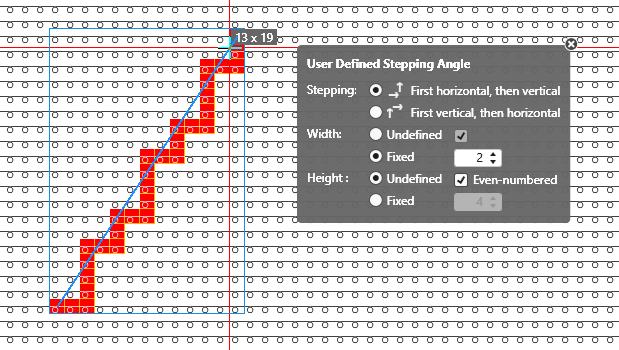
Stepping: | Specify the sequence of steppings. |
| Execute stepping first horizontally, then vertically. |
| Execute stepping first vertically, then horizontally. |
宽度: | Set the width of the steps. |
| 任意步宽 |
| 偶数列的步宽 |
| 指定宽度的步宽 |
高度: | Set the height of the steps. |
| 任意步高 |
| 偶数编织行的步高 |
| 指定高度的步宽 |


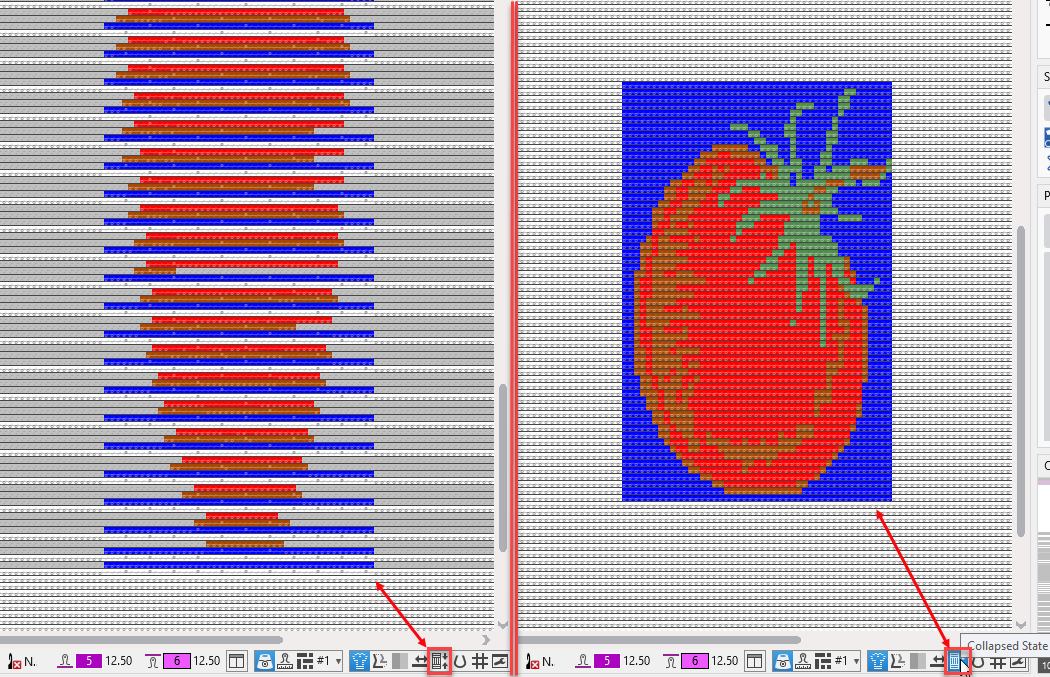
You can combine yarn carriers even in rows with a CA.
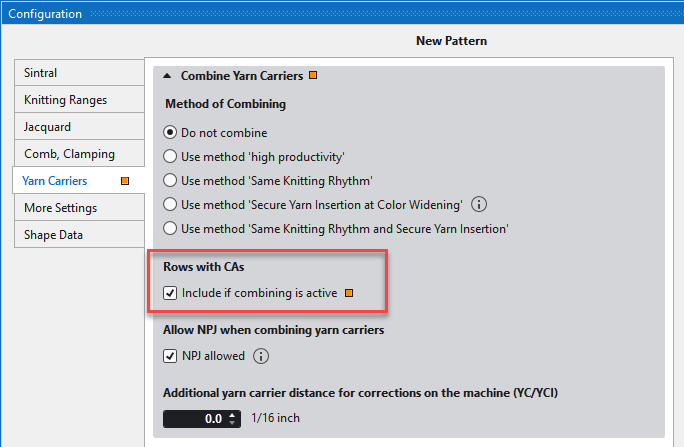
If the Include if combining is active function is enabled in the Rows With CAs section, combining then also has an effect on rows in which CAs are defined.
Combining Yarn Carriers of Selected Rows via the Control Column
You can enter the 合并导纱器 or 不要合并导纱器 option into the 导纱器预设置 control column.
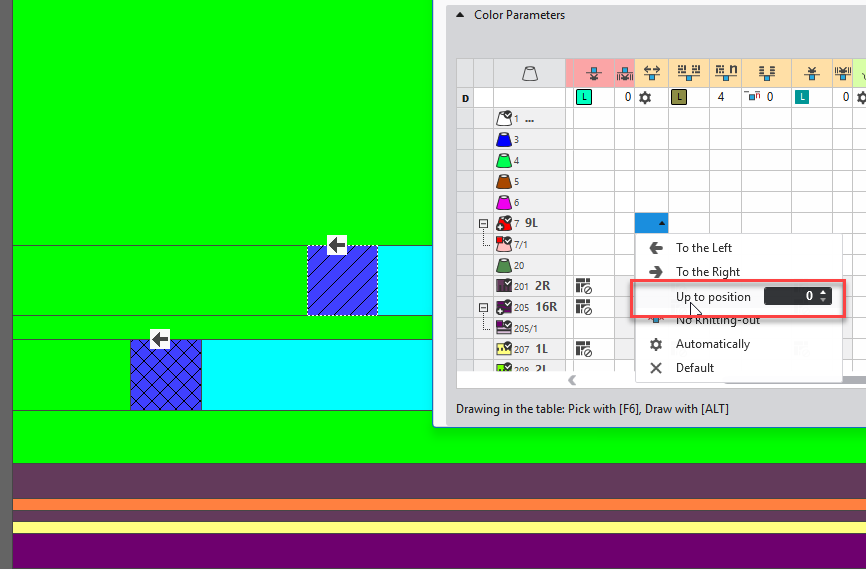
Knitting-out the Yarn Carrier up to Position Reworked
You can specify a knitting-out position of a yarn carrier in color parameters table.
Previously, this position referred to the symbol view after processing.
Now, this position referrers to Design View and you can specify it directly without preceding technical processing.
Presser Foot Type 10A
- W machines of gauge E10.2 k&w
- For use in double jersey knitting areas without effective take-down
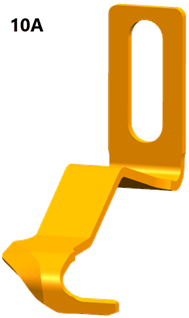
- Deflecting curve on the left-hand side
- Long foot on the right-hand side
- ID 4200306849, Typ 010
- Configuration at the W machine (EKC V3.1)
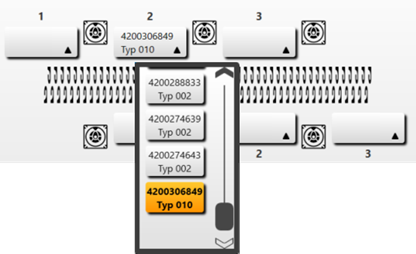
- Settings on the CREATE
- 压脚选项卡
- of Machine Properties
- of Machine Attributes
- Control column 压脚(ADF-W,CMS-W)
Filtering of Pattern Parameters Revised
You can apply the filtering of the pattern parameters to the whole Project or the active pattern in the 视图 menu bar or in the Pattern Parameters tool window.
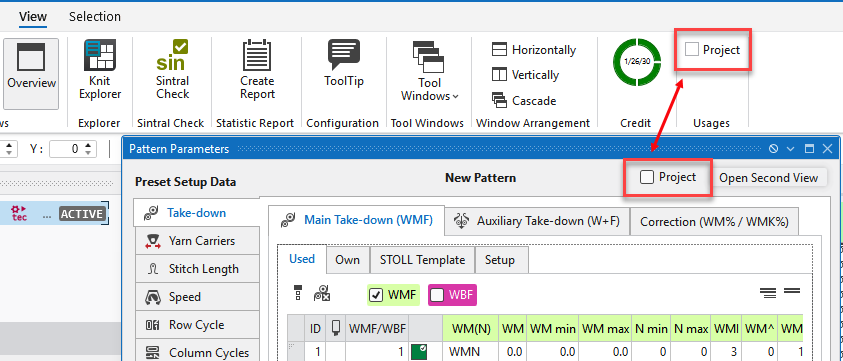
Scope of Usage
This setting applies to the following areas:
- Entries shown in the 使用 tab of the Pattern Parameters tool window
- Entries available in all the selection menus with pattern parameters
- Entries available in the context menu of the control columns
Effect
-
 Project
The entries are filtered according to the whole project.
The following entries are displayed: - All entries that are present in the patterns, in the knitting elements or in other settings of the project.
- All Sintral entries that are present in this project.
- All entries that belong to the favorites.
- All entries that are applied to the Setup.
-
 Project
The entries are filtered according to the active pattern.
The following entries are displayed: - All entries used in this pattern.
- All Sintral entries used in this pattern.
- All entries that belong to the favorites.
- All entries that are applied to the Setup.
- If a knitting element is open and active, the entries of the knitting element are displayed together with the entries of the active pattern.
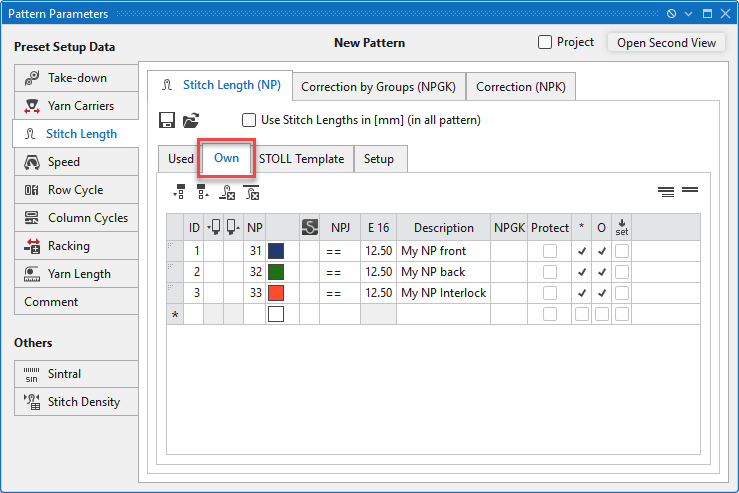
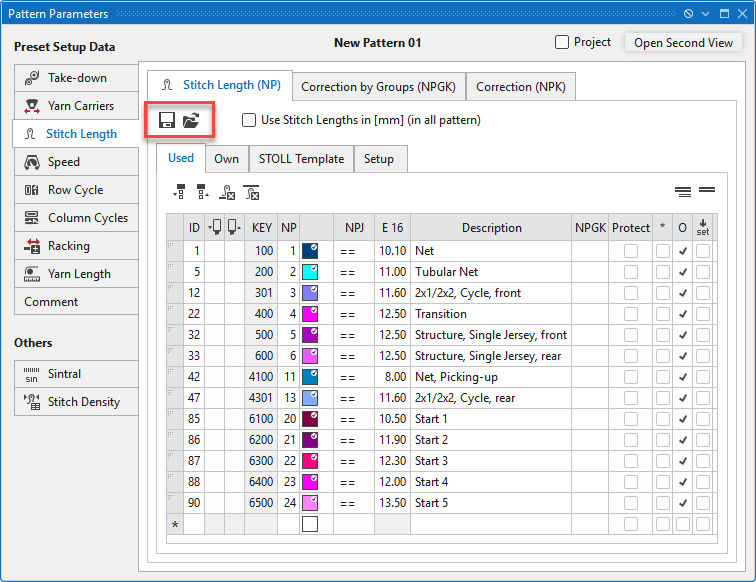
Import Pattern Parameter Template into Pattern Project
Now, you can import pattern parameter templates into an existing pattern project.
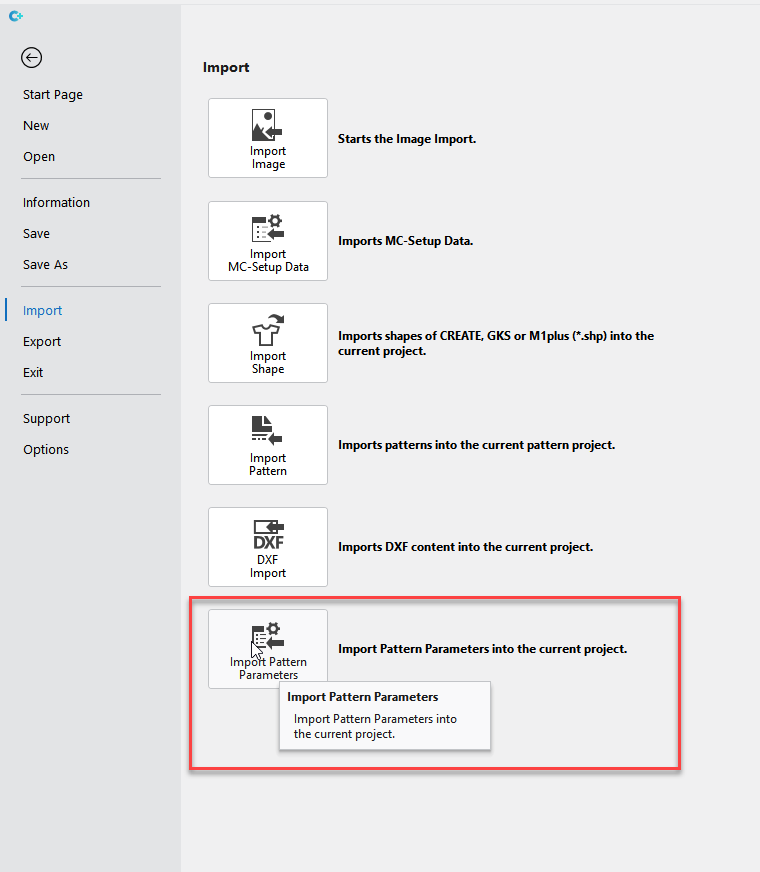
- You can open the Import Pattern Parameters function of the backstage view.
- Select the desired pattern parameter template and import it into the current pattern project.
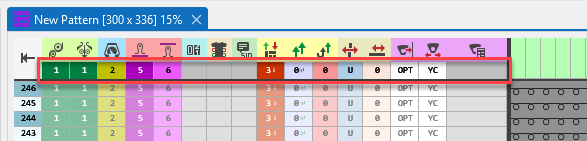
Default Setting for Control Columns within Pattern Parameters Templates
You can save the default settings of the column header of the control columns as well into the Pattern Parameters Template.
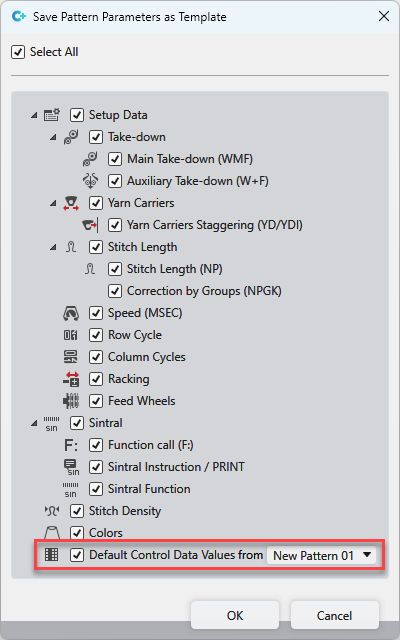
- The 将 Setup 数据保存为模板 selection dialog appears in order to export a pattern parameters template.
- Enable the Default Values of Control Columns check box of this dialog box.
- Select the pattern from which the control column data is to be transferred.
Pattern Parameters Template for Knitting Elements of the 编织资源管理器
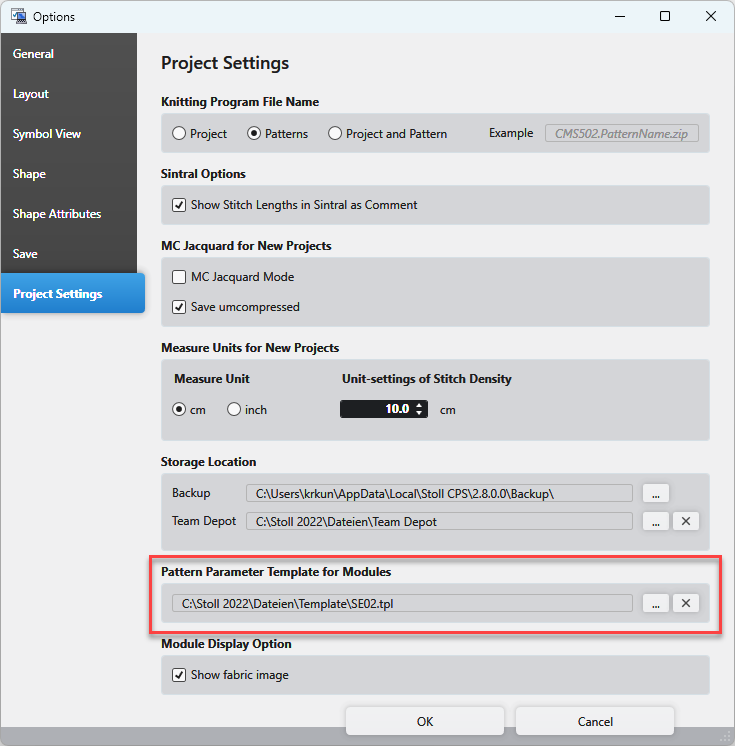
You can apply a pattern parameters template to knitting elements when you open or create them in the 编织资源管理器.
- 161
- Open the 选项 dialog box of the Backstage View.
- 162
- Load the desired template in the Pattern Parameter Template for Modules section of the Project Settings tab.
- This template is also loaded when you open or create a structure module, CA, MA or pattern element.
If a knitting element is open, you can also import any pattern parameter template.
- 163
- Click the Import Pattern Parameters function on the 导入 section of the backstage view.
- 164
- Select the desired template.
- The pattern parameters template will be loaded into the knitting element.
Additional identifier for the entries in the tables of pattern parameters
Almost all pattern parameters table have the new 名称 column.
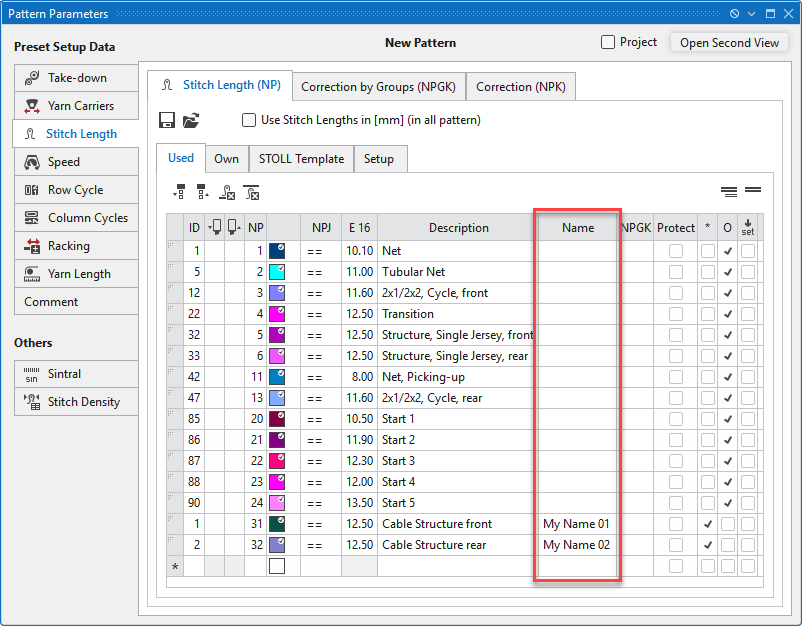
- This identifier enables the entry to be uniquely identified.
- This identifier cannot be entered more than once in a table.
- Entries from different tables can have identical identifiers.
Behavior:
- Requirements
- A module, pattern element or shape with an entry that can be identified by an identifier was loaded into a pattern.
- The pattern contains entries with identical identifiers.
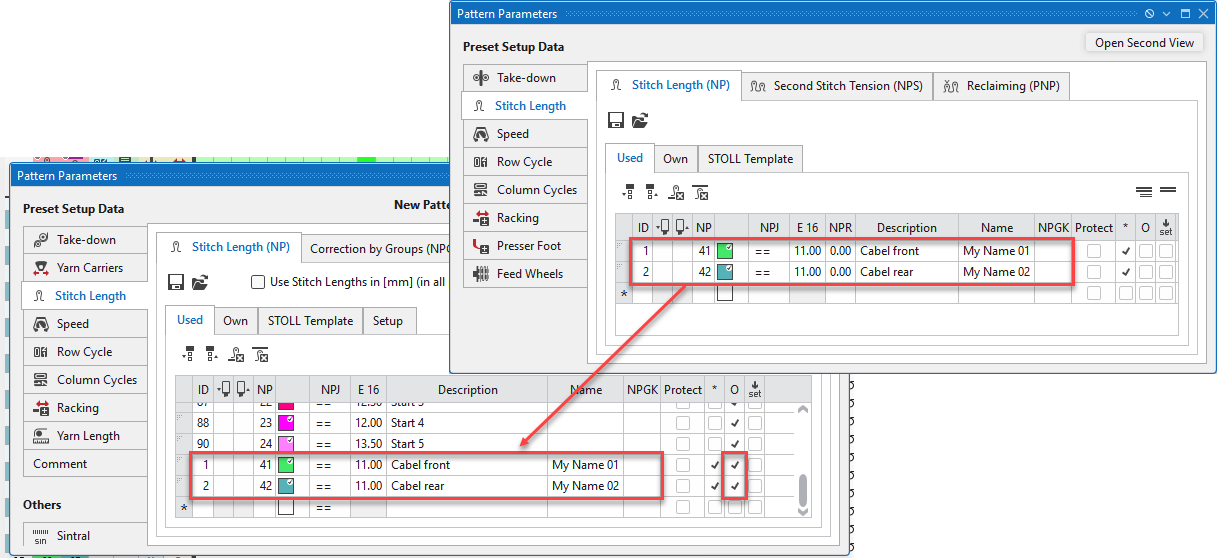
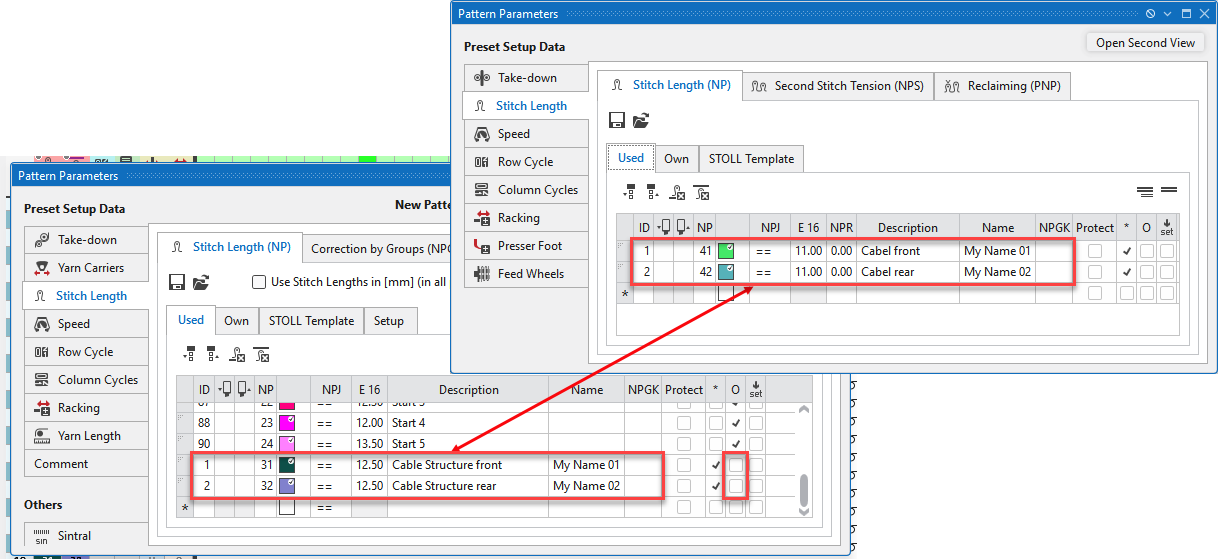
- The O column determines the effect
- If the check mark is set in the O column for entries in the pattern:
- The entry from the module, pattern element or shape overwrites the corresponding entry in the pattern.
-
- If the check mark is not set in the O column for entries in the pattern:
- The entry of the pattern is retained.
- The entry from the module, pattern element or shape is ignored.
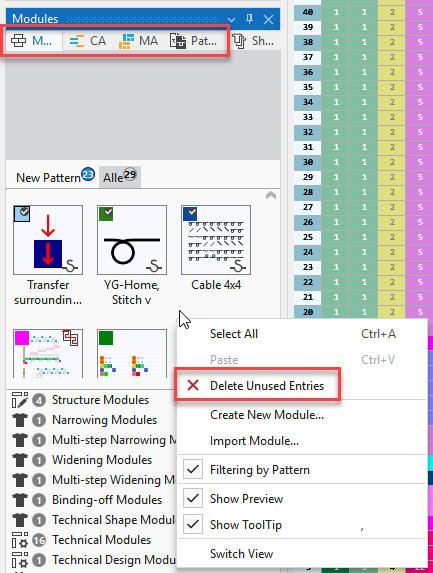
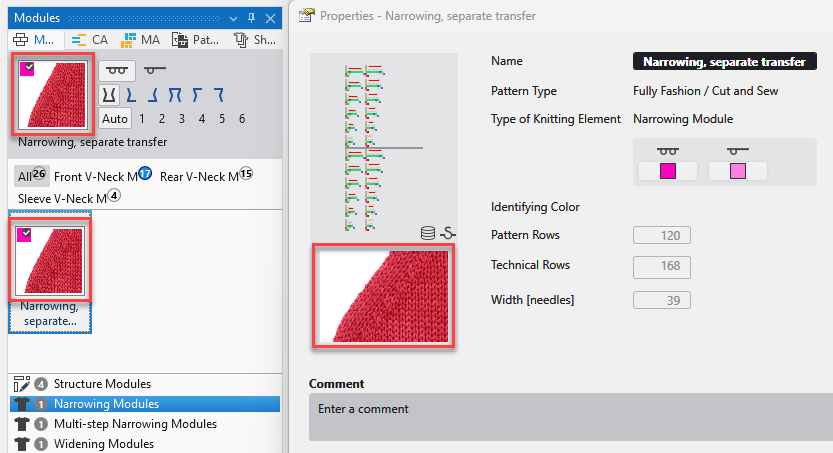
Recognition Images for Modules
- An image file can be assigned to each module in its properties for better visualization.
- This image is displayed wherever the module can be selected.
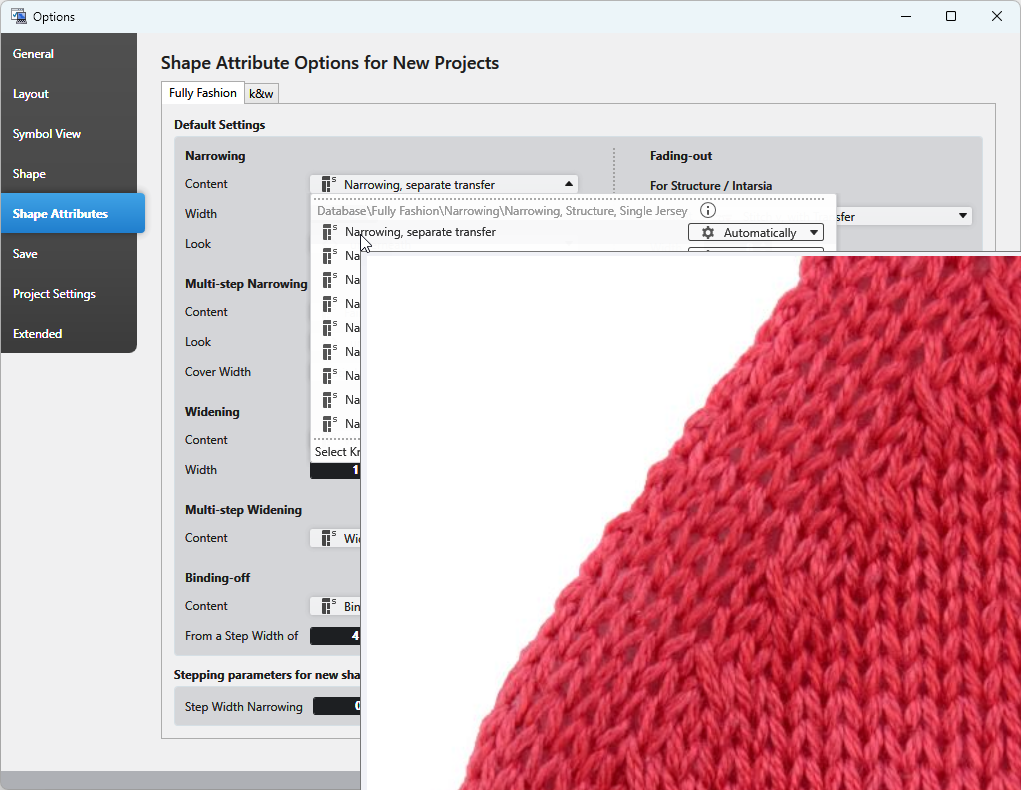
- The image is displayed as a tooltip in the selection menus.
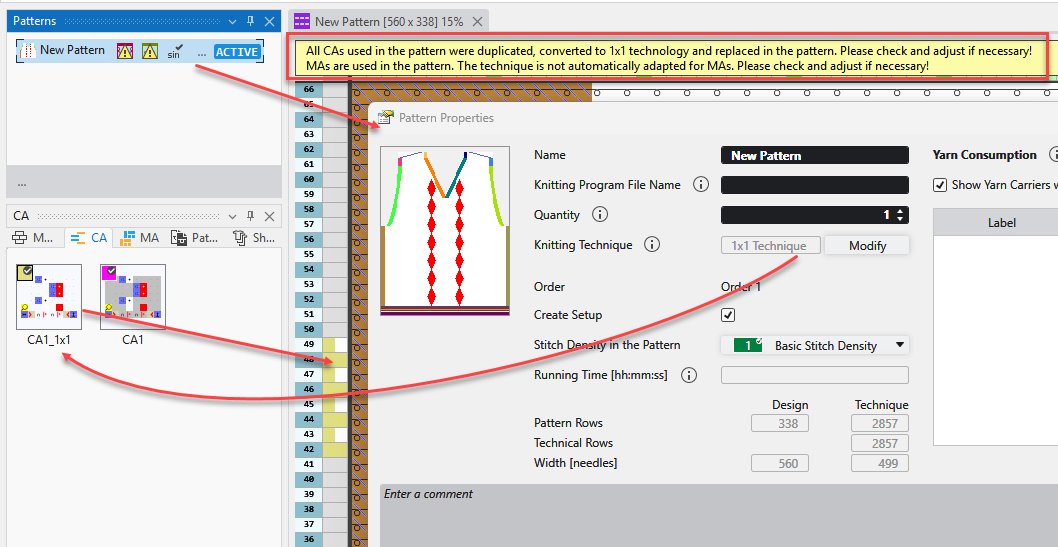
You make the settings for the module display in the Project Settings tab of the 选项 dialog box: Show Fabric Image
Delayed Casting-off with Binding-off Modules
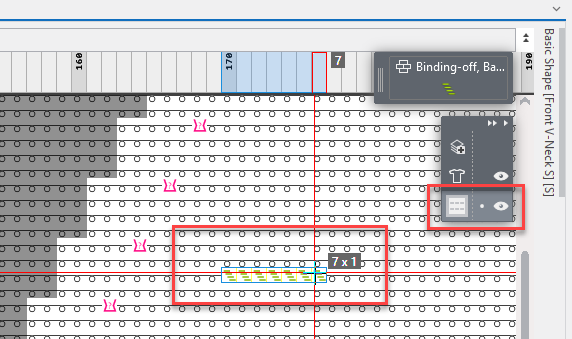
With binding-off modules, it may be necessary to insert the final binding-off with a spacing into the pattern.
In the binding-off module, the final binding-off rows are therefore marked with the # symbol in the row definition column.
The properties of the module contain this function:
Delayed Cast-off
Cast-off After Pattern Rows 
If the function is active, the drop rows marked with # are entered into the pattern with the specified offset.

Alternative Shape Edge or Color Field Edge in CA
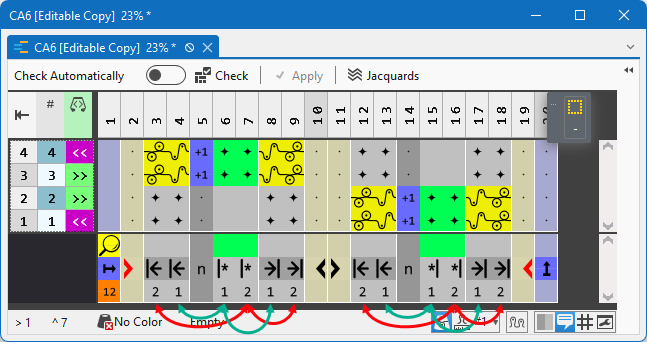
- In the color segment, mark the columns of the repeating area with numbers.
- Draw different border areas to the left and right of the repeating area and mark them with the respective numbers.
- The numbers of the edge columns of the repeat area in the pattern define the shape edge areas or color field areas to be used for the left and right.
- If the left edge column of the inserted repeat area in the pattern is marked with the number 1, then the left edge area marked with the number 1 is inserted to the left of it.
Marked green in the example image - If the right edge column of the inserted repeat area in the pattern is marked with the number 2, then the right edge area marked with the number 2 is inserted to the right of it.
Marked red in the example image

The same applies to the shape edge:
Raster-Shape as Pattern Element
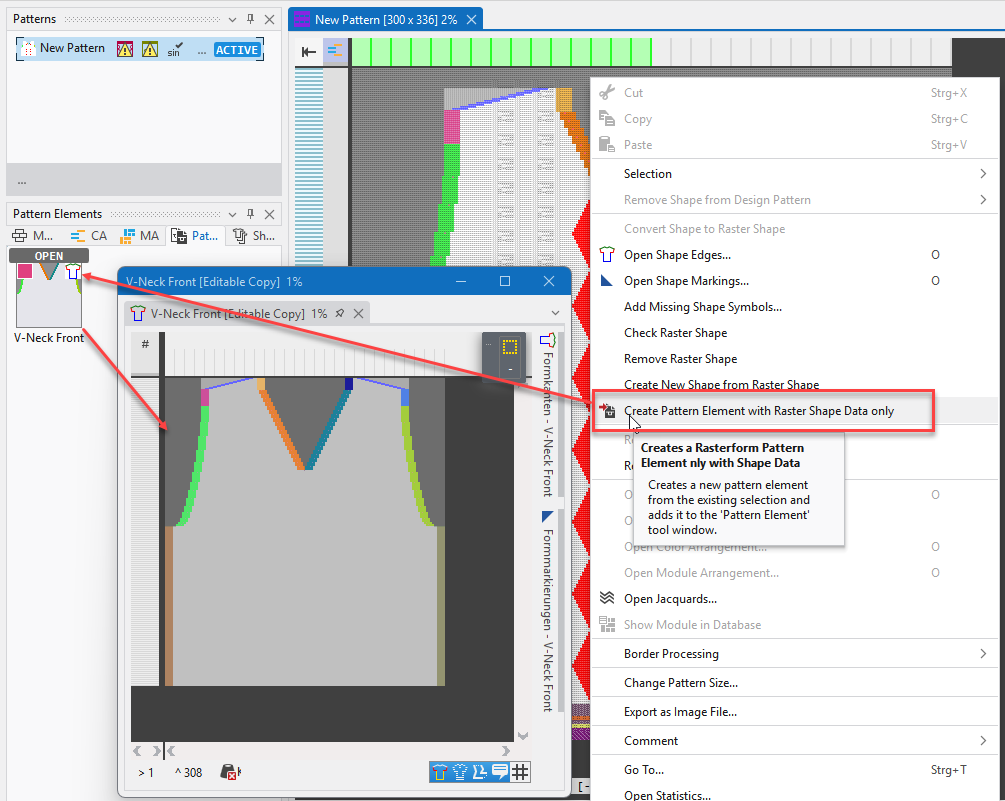
You can create and handle raster-shapes as a pattern element.
- Select an area of the pattern with raster-shape.
- Call up Create Pattern Element with Raster Shape Data only function of the context menu.
- Or create it without selection from the entire design.
- The pattern element only consists of shape edges, shape markings and shape symbols.
All the other data will be ignored. - You can draw with these three only.
- Marking

With it, raster shapes can be saved, edited and applied to any pattern quickly and easily.
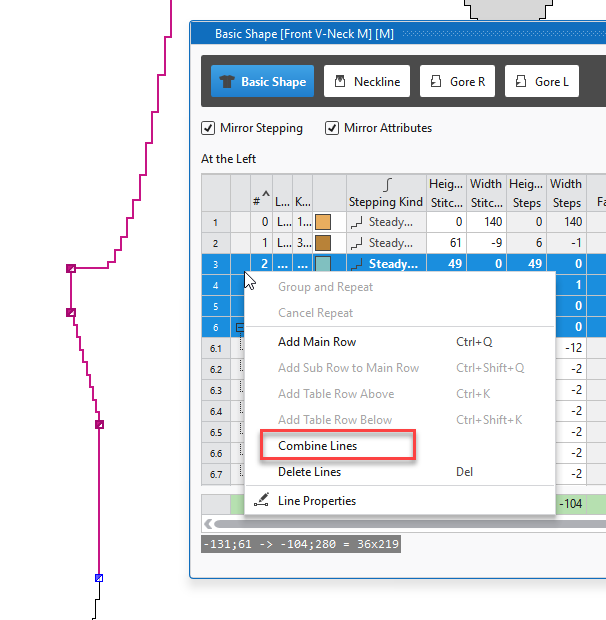
Combining Main Shape Lines
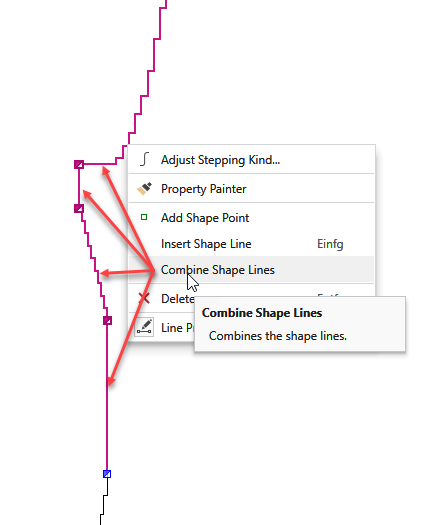
In a lined shape with input format stitches or steps, several contiguous main lines can be combined into one main line.
- 166
- Select several connected lines in the lined shape view.
- 167
- Click the Combine Shape Lines function of the context menu.
- The lines are combined into a user-defined line.
 用户自定义 Curve Type
 You can select and combine the lines in line table as well.
Combine Shape Lines function of the context menu
Create Shape From Image
- 168
- Activate the
 从图片创建模型 option in the 新建线模型项目 or 新线模型 dialog box.
 - 169
- Load the desired image with 加载图片....
- 170
- Click the desired color of the image with the cursor.
- The color appears under Colors for Outside Shape.
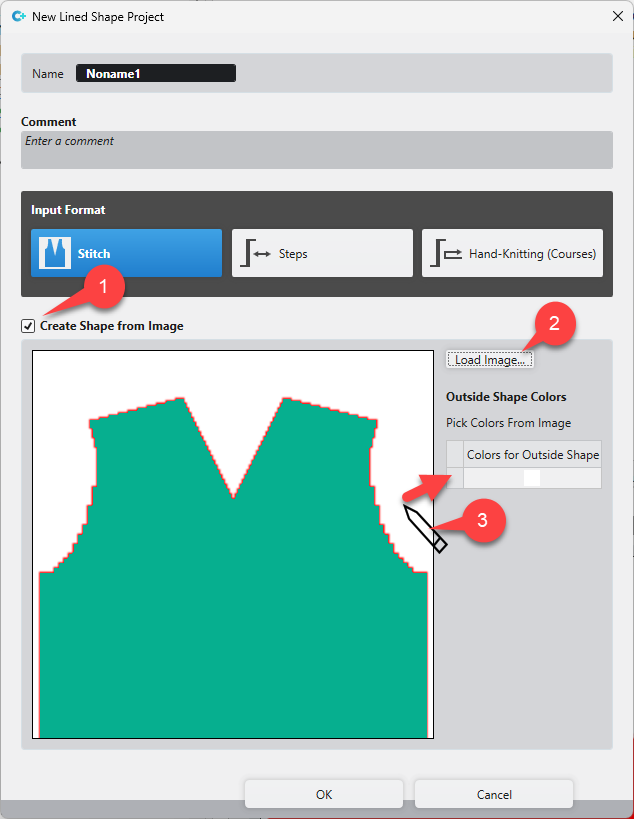
- 171
- If desired, click more colors.
- 172
- Close the dialog box with OK.
New lined shape project (dialog box)
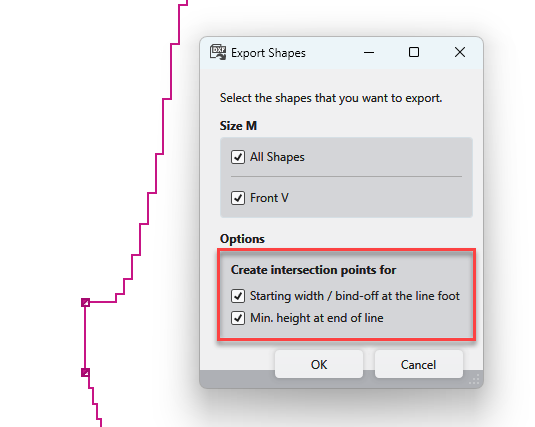
DXF Export Reworked
The Lined Shape Editor provides the Export as DXF File function.
This saves the selected lined shape as a DXF file.
This function was reworked.
When exporting, new shape points can be created in the following dialog for the start width and the minimum height at the end of the line.
As a result, the DXF shape is created true to size according to the lined shape.
You can find the news of the previous releases in the CREATE 帮助 (F1) help.
其他信息
- All Videos About V2.10
- Importing Knitting Elements of M1plus into CREATE
- What was new in CREATE PLUS V2.9
- What was new in CREATE PLUS V2.8
- What was new in CREATE PLUS V2.7
- What was new in CREATE PLUS V2.6
- What was new in CREATE PLUS V2.5
- What was new in CREATE PLUS V2.4
- What was new in CREATE PLUS V2.3
- What was new in CREATE PLUS V2.2
- What was new in CREATE PLUS V2.0 and V2.1